 Knowledge Library
Decision in brief
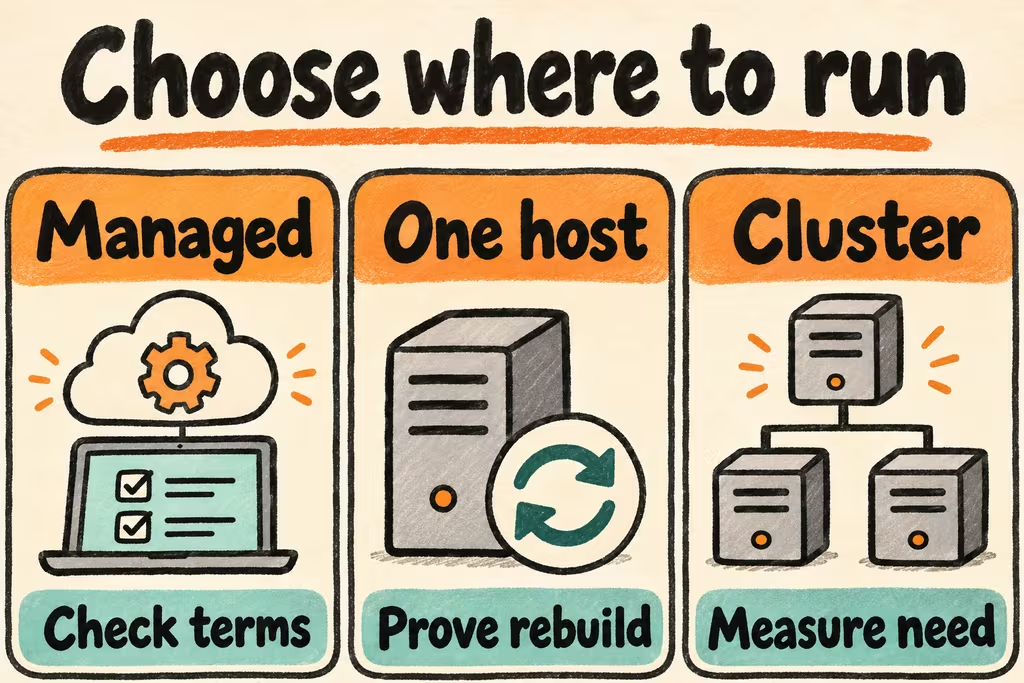
Start with a managed service when its access, data export, and recovery terms fit and the team has limited time to operate it. Use one replaceable host when you need more control and can rebuild within the service's downtime budget. Evaluate a cluster when a measured availability, placement, or release requirement exceeds the simpler baseline.
Find a guide
Choose where a service runs
- Self-Hosted vs Cloud: Compare Cost, Ownership, and Recovery
- Docker Compose in Production on a Single Host
- When to Use Kubernetes and When a Simpler Platform Meets the Need
Keep services reachable and observable
- Tailscale Alternatives: Headscale, NetBird, and WireGuard
- Self-Hosted Monitoring Tools for Uptime, Metrics, and Logs
- Docker Monitoring for Container Health, Resource Pressure, and Service Alerts
Manage access and recover from failure
- Self-Hosting Security for Private Access, Maintenance, and Recovery
- Kubernetes Troubleshooting by Pod State, Service, and Rollout
- Best Self-Hosted Apps to Start With by Workload
Choose browsers, credentials and mobile stacks
- Firefox vs Chromium: Browser Compatibility, Extensions, and Switching
- How Do Passkeys Work? Set Up, Sign In, and Recover Access
- React Native vs Native: Performance, Build Cost, and Support
Prepare for outages and recovery
- Cloudflare Outage Postmortem: Map Dependencies and Rehearse Recovery
- Security Incident Response Checklist for Dependencies, Containment, and Recovery
- TLS Certificate Authority Migration for Public Websites
Protect or move a software platform
Pick an operating model before picking tools
Write down who uses the service, what data it owns, and how long users can wait during an outage. Then assign ownership for patching, access changes, backups, and incident response. A cloud VM still leaves guest operating system updates and application configuration with the operator in common infrastructure-as-a-service arrangements.
Choose remote access according to the audience. A small group with enrolled devices can use a private network. Public users need a reachable application endpoint with a separate administrative path. Give a user-facing check a network position that represents its users and give the alert receiver an owner.
| What you need | First option to evaluate | Test that decides |
|---|---|---|
| Public site or standard app with limited operator time | Managed app or hosted service | Recover an export and verify access rules, support responsibilities, and expected downtime. |
| Private app with persistent data on a small footprint | One replaceable VM or server, with Compose if the app has several containers | Enroll and revoke a test device, then rebuild on a second host from an off-host copy. |
| Several workloads with different release schedules or tighter host-failure goals | Compare managed orchestration with the single-host baseline | Measure user impact from a bad rollout and loss of one worker while checking the recovery path for state. |
| An existing service with unclear downtime or incidents | Add an independent service check, then instrument one suspected bottleneck | Trigger one synthetic failure and see which signal leads to an action. |
Use HN accounts to identify what to rehearse
In a thread about operating a FreeBSD server at home, tombert described keeping Jellyfin and n8n on a self-managed machine while moving simpler workloads such as a blog to hosted infrastructure. The work of keeping services available and the size of the media library shaped that split. Estimate operating effort and storage for each service separately.
In a separate Tell HN, neilfrndes reported that the private path between a managed application cluster and its managed database stopped responding after an update. That report suggests probing a real dependency from the application network and assigning responsibility for escalating through the provider when a component outside your control fails.
Pilot the workload through a normal week and a failure
- Choose one service and load it with synthetic data. Record the weekly time available to operate it, the maximum acceptable recovery time, and the maximum age of restored data.
- Deploy on the simplest candidate platform. Walk through sign-in, a real application operation, and a scheduled backup. Add an external or private-path check according to the actual audience.
- Break a staging dependency and time detection, acknowledgment, and recovery. Separately restore the app on a clean target using the documented configuration and a retained copy of its data.
- Accept the platform only if a second operator can follow the runbook, recovery meets both objectives, and estimated maintenance fits the time budget. Pause any move where an essential dependency, escalation path, or data export has no owner.
Software platforms, open source and supply chain security
Start by identifying what can break. A provider outage interrupts an external dependency, a package incident changes what you can trust in a release, and a planned hosting migration changes who owns access and recovery. The corresponding guides above lead to different tests.
OuterVale shared GitLab’s report of an npm supply chain incident on HN. It is a reason to tie a deployed artifact back to known inputs and owners. In another thread, Philpax shared Anthropic’s account of redesigning source control. That case raises a different test: confirm that permissions, history, and automated checks survive a change in platform workflow.
- Pick one benign scenario for a service you own, using a test repo and synthetic dependency records.
- Write down the source of truth for service status, artifacts and access. Record who can authorize a change.
- Follow the relevant guide and ask a second operator to trace a known-good release, restore or migration using its evidence.
- Accept when the second operator can identify the affected asset and complete the recovery check unaided. Stop if evidence is missing or permission transfer has no accountable owner.
| Your symptom | Guide to open | First check |
|---|---|---|
| Users cannot reach the service | Cloudflare outage postmortem | Check origin health, DNS, and independent service status separately. |
| An upstream package or build is under review | Security incident response checklist | Record deployed digests, the affected component, and accountable services. |
| A repository or build service needs to move | Self-hosted Git server and migration | Test read and write permissions, CI artifacts, and the original rollback path. |
| A project loses its primary maintainer | Open source project handover | Have a second authorized maintainer repeat a release and recovery drill. |