 Knowledge Library
Decision in brief
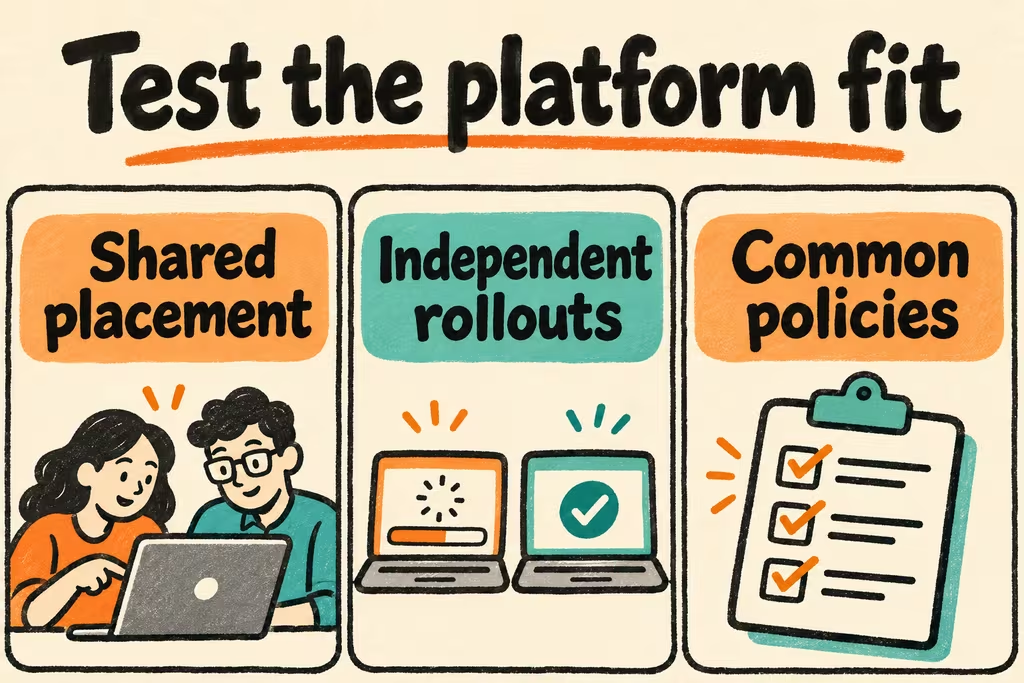
Use Kubernetes when several workloads need common placement across machines, independent rollouts, or standardized platform policies, and a team can run those controls through upgrades and outages. Start with a managed application platform or a single-host deployment when the operating requirements fit there. Compare platforms at the workload and on-call level before migrating.
Identify which Kubernetes capability earns its cost
Kubernetes schedules Pods and reconciles declared workload state. Deployments can manage replicas and rolling updates. Services provide stable access to matching backends. These capabilities depend on the control plane, available worker capacity, networking, and the workload's readiness and storage choices.
Managed Kubernetes can take responsibility for operating the control plane. Confirm who owns node updates, admission policies, ingress, storage, identity, and incident response under the specific plan. Service recovery requires available worker capacity and a data recovery design for stateful workloads.
| Workload situation | Baseline to compare | Kubernetes decision trigger |
|---|---|---|
| One small service with a tolerant recovery period | One VM, container host, or managed application service | A documented host-failure or rollout requirement exceeds the baseline |
| Several teams ship independently | Managed container hosting and managed Kubernetes | Shared policy, workload APIs, and ownership can be demonstrated on real services |
| Many identical stateless replicas | Managed container hosting with autoscaling | A common scheduling or scaling requirement needs cluster-level controls |
| Stateful application with a strict restore requirement | Managed database alongside either app runtime | The application team can test data recovery independently of Pod replacement |
Use HN experience to set the platform baseline
In the Uncloud announcement, creator psviderski described operating Kubernetes in small and large environments and seeing teams that mostly needed rollouts, networking, and HTTPS across a few machines. Make those needs explicit and measure the simplest platform that meets them.
In a separate discussion about learning Kubernetes, burdock described experimenting with alternatives to text templating in Helm. Include the time for a second operator to trace a change from source configuration through generated resources to the running service. A rollout speed measurement alone misses that work.
Deploy one representative workload to both candidates
- Choose a real workload pattern with synthetic data and one measurable traffic requirement. Write down expected peak requests, the rollback and recovery windows, and how much operator time is available each month.
- Deploy the same image to the current baseline and a disposable Kubernetes environment. Time the work to configure ingress, identity, observability, and persistent storage if required.
- Run a good rollout, an aborted rollout, and a worker or host loss. Record failed requests, time to restore useful traffic, and which actions required elevated access or off-hours intervention.
- Adopt Kubernetes only if it meets an explicit requirement the baseline misses and a second operator can release and recover the service from the runbook. Stop if routine upgrades, rollback, or data recovery still have no owner.