 Knowledge Library
Decision in brief
Keep personal services on a private network when all intended users can enroll devices. For public apps, publish the required application endpoint and put administrative paths behind a separate access policy. Assign patch ownership and keep a recoverable copy of data outside both the live host and its routine credentials before depending on the service.
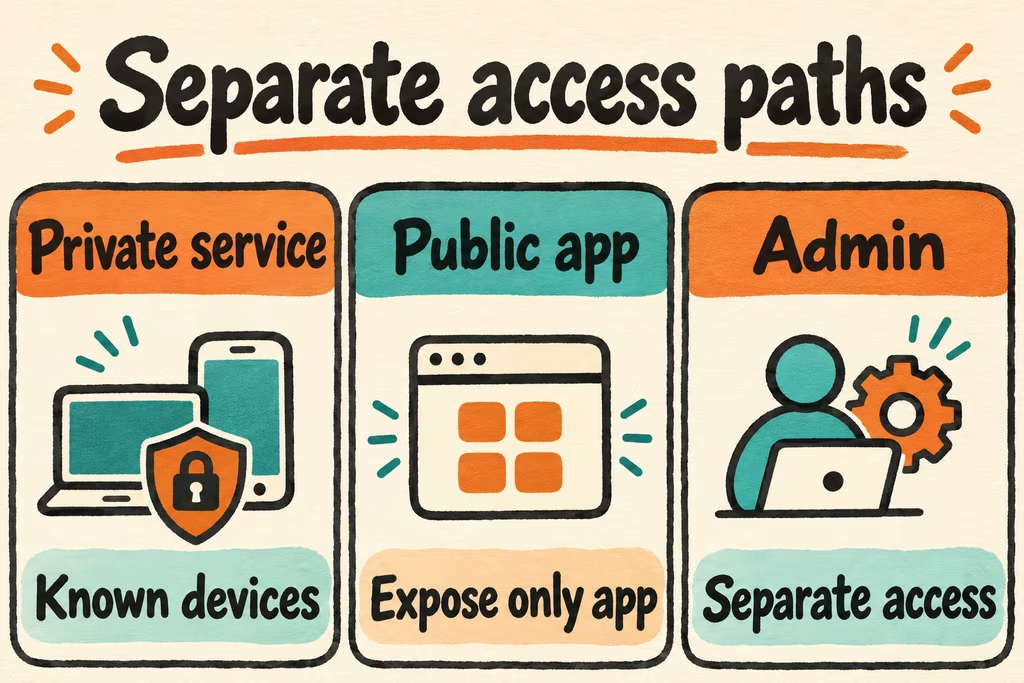
Draw the access and recovery boundaries
Inventory the expected routes for users, administrators, and automation. Require individual identities for administration and remove unused accounts. Scope a private overlay's grants to approved users or machines and required ports. Confirm permitted and prohibited paths from separate test devices. A private route still needs application access checks and timely updates.
Use a separate repository or destination for recoverable copies. Keep encryption recovery material available through a path independent of the running host. Apply retention controls so a routine service identity cannot erase the only recovery copy. Include data, settings, and a record of required secrets in the recovery plan, with secrets kept in appropriate restricted storage.
| Situation | Boundary to apply | Evidence before relying on it |
|---|---|---|
| Household-only app | Private network with narrow device and service grants | An enrolled user can perform the intended task. An unenrolled device and a revoked account cannot. |
| Internet-facing workload | Public application endpoint and private administrative access | A public test user can use the promised route. The management interface stays unreachable from that path. |
| App and backup use the same machine | Independent backup destination and separate retention authority | The live host's service identity cannot delete the protected recovery copy. |
| Equipment loss or account loss | Documented fresh-host recovery with separately retrievable credentials | A second operator restores application data, verifies contents, and records elapsed time and recovered data age. |
Use HN cases to choose the checks that matter
In a self-hosting discussion, simonw described choosing Tailscale to reach a home server from enrolled devices without directly publishing its service ports. Translate that setup into a list of intended user-to-service paths. Test an unenrolled device and revoke a test device to verify the boundary.
In a different backup discussion, PunchyHamster described running restic and automating attempts to restore randomly selected backups. Apply the same idea in a clean environment. Verify that the restored data opens in the application and time the work so the result can inform your recovery goal.
Run an access, update, and restore exercise
- Build a test copy using synthetic records. Record the intended listeners and the identities expected to reach them. Set a maximum time to revoke access and a recovery time and data-age budget.
- Use one authorized and one unauthorized test device to verify application and administrative access. Revoke the authorized test identity, then measure when a fresh session is denied.
- Apply a supported update and verify normal use afterward. Restore a retained snapshot into an isolated clean target using the documented recovery credentials. Check a few known records and one application operation.
- Use real data only after access, revocation, and recovery meet the agreed checks. Stop if an unauthorized device can reach management, an update lacks a maintainer, or the only remaining recovery material lives on the original host.
Related articles
- Docker Container Security for Trusted Services and Shared Hosts
- Kubernetes Security Checklist for Workload Admission, RBAC, and Network Policies
- Database Security Controls for PostgreSQL Services and SQLite Files
- Self-Hosted vs Cloud: Compare Cost, Ownership, and Recovery
- How Do Passkeys Work? Set Up, Sign In, and Recover Access