 Knowledge Library
Decision in brief
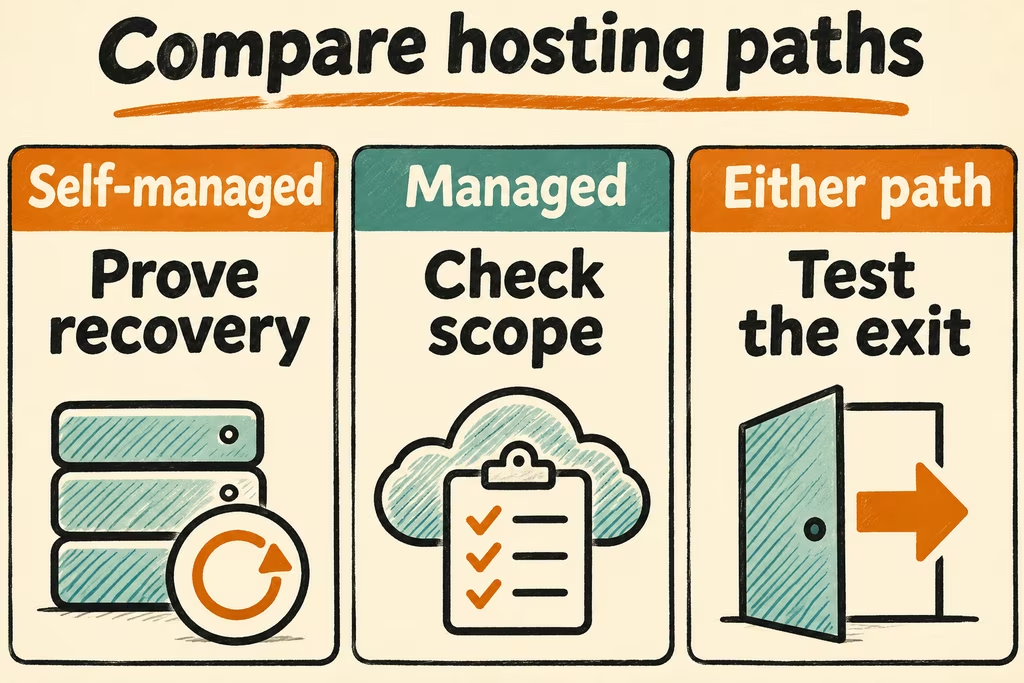
Choose self-managed hosting when location or control is a concrete requirement, workload demand is predictable, and an owner can demonstrate recovery. Choose managed hosting when its responsibility boundary covers work you cannot reliably staff. Compare an equivalent service level over the same period and account for your time and a tested exit.
Price responsibilities at the same service level
A self-managed cloud VM gives the provider responsibility for its infrastructure while you typically own the guest operating system, application, and data. Managed offerings differ in the patching, backup, failover, and export work they take on. Verify the boundary at the service and plan level.
Build a monthly estimate with hardware amortization, measured power, network service, storage, backups, transfer, support, and staff hours. Calculate power as average kilowatts multiplied by operating hours and your local tariff. Model peak usage and one incident as separate scenarios. Compare the same recovery time, recovery point, and support hours in each scenario.
| Driver | Self-managed baseline | Managed baseline |
|---|---|---|
| Private access and control of hardware | Inventory local power, connectivity, remote access, patching, and spare hardware | Check region, connectivity, data handling, and access logs |
| Predictable low demand | Include the host, off-site copies, and routine labor | Price equivalent compute, storage, backups, and expected transfer |
| Unpredictable demand or limited staffing | Measure the work to add capacity and respond after hours | Verify scaling limits, escalation hours, and support response terms |
| Portability | Restore the application and data on a second machine | Export data and exercise replay or restore outside the service |
Treat operating effort as a measured quantity
In a discussion about self-hosting, simonw described private remote access making a home server more acceptable because it reduced the need to expose ports directly. For a similar service, test access from an approved remote device and confirm who will patch the host and access tooling.
In a separate discussion about CI hosting, senoff reported trading variable hosted-runner costs for one self-managed machine and encountering memory and scratch-space issues. Record migration, restore, maintenance, and coverage hours alongside provider charges. Attach the team’s estimate for an hour of operator time.
Run a seven-day ownership and exit trial
- Choose one service and a representative demand and data profile. Quote a local, self-managed VM, or managed option using a common availability objective and list each ongoing task with an owner.
- Run two small staging deployments for a week. Track power or provider consumption, operator hours, staged peak load, and routine update time. Pro-rate any recovery drills separately from steady-state costs.
- Restore synthetic data to a clean instance and export it into a second environment. Measure endpoint switch time, restored freshness, and changes to access and audit history.
- Select an option only when the expected and peak cost fit the budget and both restore and exit meet the declared targets. Stop if an essential task still has no owner or the data cannot be exported in a usable form.