 Knowledge Library
Decision in brief
Assign an incident lead, preserve the smallest useful evidence set, and identify which identities, builds, or vendor data paths are in scope. Have the responsible owner approve containment and test recovery in isolation. Track customer impact and outstanding work separately from the technical restoration decision.
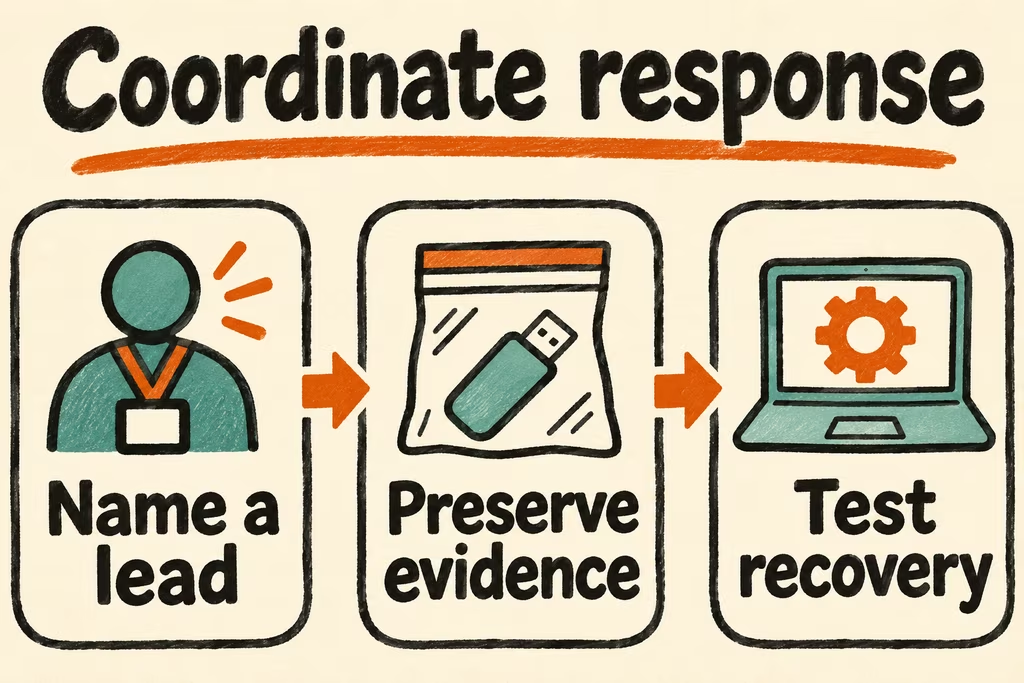
Decide from evidence and assign owners
NIST SP 800-61 Rev. 3 frames incident response as part of ongoing risk management. Translate it into an incident log with an owner, timestamp, confidence and next check for every important assertion. Keep the narrative factual and use established internal reporting for credentials, personal data and customer communications.
For a dependency advisory, record the installed version, build or deployment time, trust boundary and authority for action. For a vendor notice, inventory data fields and integration owners. Failure to verify exposure leaves an open question that should remain visible during restoration and handoff.
| Phase | Item to record | Required handoff |
|---|---|---|
| Confirm scope | Affected and explicitly excluded systems, builds and identities | Incident lead agrees the boundaries and assigns gaps |
| Preserve and contain | Restricted evidence location, containment decision and authorizer | Owner confirms important logs are preserved and access is controlled |
| Restore | Approved build or backup, credential and integration checks, validation result | Service owner and reviewer sign off on critical paths |
| Review | Impact timeline, unresolved exposure and maintenance task owners | Every follow-up has a date and a way to verify completion |
Two Hacker News cases that expose inventory gaps
In the HN discussion of GitLab’s npm incident reporting, rkagerer raised the difficulty of knowing what an install will do on a workstation. Convert that concern into an inventory check for which apps use an affected version and which builds ran in the relevant window. The HN comment supplies the question. Use verified advisories and your own inventory for the answer.
In a separate HN thread about a Mixpanel incident disclosure, Hannah203 emphasized the risk from data carried through third-party tools. During a drill, ask the owner of each vendor integration to identify approved data fields and produce the corresponding settings or data-flow record. The public disclosure documents the specific event.
Rehearse an incident with synthetic evidence
- Prepare a tabletop exercise with a fictitious advisory, dummy credential, synthetic logs and a known-good staged artifact. Assign the incident lead, application owner and communications owner.
- Time how long it takes to find the affected staging build and vendor data fields. Record which evidence supports each assertion, preserve it in the exercise’s restricted location and get approval for the containment decision.
- Run the documented recovery on staging with the synthetic identity and known-good build. Check authentication, critical functionality and logging. Record the reviewer, recovery time and remaining gaps.
- Accept if assigned owners can find the evidence, authorize containment and verify recovery within the declared windows. Stop if any step touches live credentials, alters production, exposes personal data or leaves impact unattributed.