 Knowledge Library
Decision in brief
Use Headscale if you specifically want to operate the coordination server and your required Tailscale client features pass a trial. Evaluate NetBird when you want a separate WireGuard-based overlay with managed or self-hosted deployment. Choose direct WireGuard for a small, stable set of peers you can configure yourself. Keep managed Tailscale if it already meets the access requirements and the plan costs less than operating an alternative.
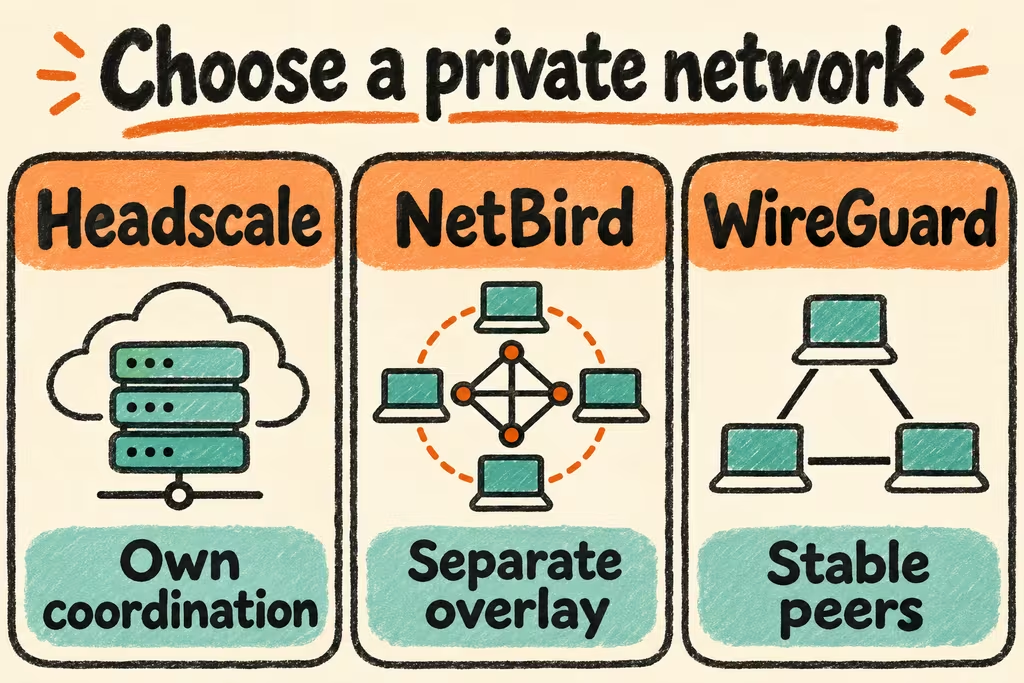
Which Tailscale alternative fits your network?
Separate the data path from the coordination work. Your trial needs to cover identity, device enrollment, identity recovery, access rules, and connectivity when a direct route fails. Check current mobile and desktop client behavior and test from the networks users actually join.
For a free Tailscale alternative, count people and devices against current official plan terms and verify the access features you use. For self-hosting, include service hosting, storage and backups, relay traffic if applicable, and time to patch and recover the service.
| Option | Good fit when | What to verify |
|---|---|---|
| Tailscale | A managed coordination service and official clients already meet requirements | Plan limits, device enrollment, required identity and sharing flows. |
| Headscale | You want to self-host coordination and retain compatible Tailscale clients | Features listed by the project, required client platforms and enrollment, relay dependencies, and recovery. |
| NetBird | A separate managed or self-hosted overlay fits how you govern access | Identity provider, grants between groups, routes, DNS, and behavior when clients connect over restrictive networks. |
| WireGuard | A small, stable peer set can be configured and audited manually | Key rotation, endpoint reachability, allowed networks, and an assigned owner for configuration. |
HN migration and self-hosting cases
In Show HN, hwdsl2 described a Docker package to automate Headscale setup and initial enrollment. That case is useful for estimating setup effort. Treat certificate renewal, coordination-server restore, and enrollment after an upgrade as separate operational tests.
In a NetBird discussion, binnacle reported intermittent connection failures for a subset of users during a move from Twingate to a self-hosted setup. Use that report to include both ordinary Wi-Fi and restrictive networks in the pilot. The account describes one environment and gives no baseline for other deployments.
Run the same rollout and revocation test on each option
Use two noncritical client devices and a staging service. Agree on a reconnect time, a revocation target, and a maximum amount of operator work per month using the level of access the service needs.
- Enroll a user and a second device. Use test identities to confirm that an allowed user reaches the intended service and an out-of-scope user cannot. Verify name resolution and the actual app response.
- Repeat on home Wi-Fi and a phone hotspot. Where the product exposes diagnostics, record whether traffic is direct or relayed. Check the experience after sleep, a network change, and a client restart.
- Revoke one enrolled test device and verify the change from both a fresh connection and an existing test session. For a self-hosted setup, rehearse restoring the coordinator on staging and record if users must enroll again.
- Pilot a single user group if the candidate meets the agreed targets. Keep a verified administrative access path and record a rollback procedure before removing the old overlay.