 Knowledge Library
Decision in brief
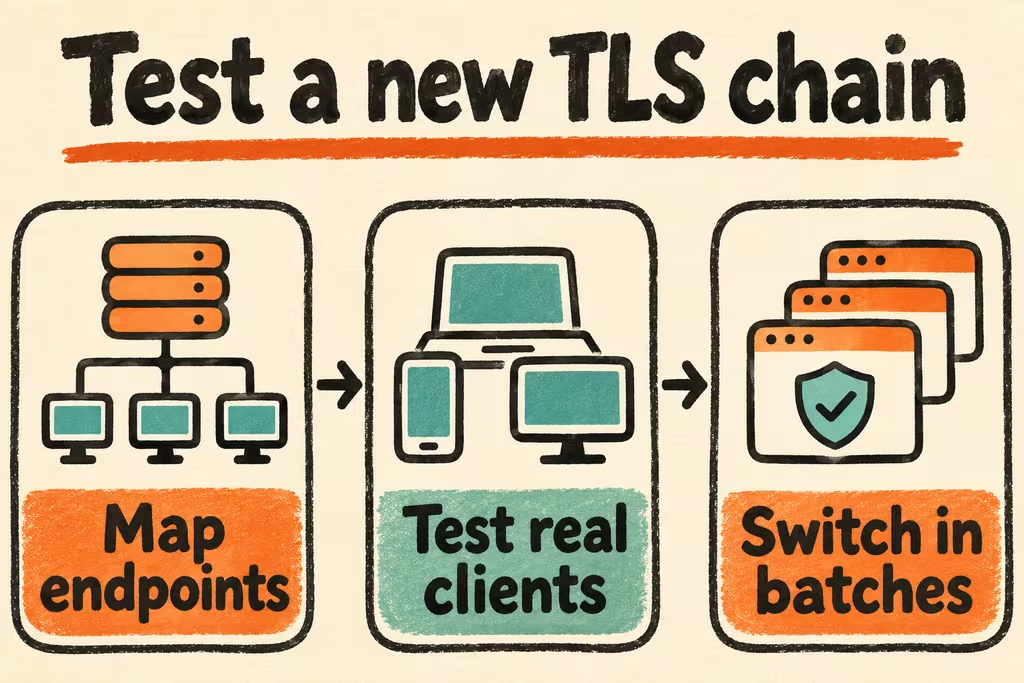
Map which services issue and terminate TLS, then prove the replacement chain on the clients you actually support. Use a staging hostname you control, keep rollback settings ready, and switch production in measured batches. Roll back only to an issuer and certificate that remain valid and trusted.
Check authority, serving layer and trust separately
Changing issuer can affect at least three independently managed layers. Issuance may require updated CAA authorization, successful domain control validation, and working renewal automation. Actual traffic depends on the certificate and intermediates served by the CDN, load balancer or web server. Acceptance depends on the trust stores and requirements of the clients that connect.
For managed edge certificates, verify whether your provider and plan offer issuer choice at all. Cloudflare documents that Universal SSL customers cannot choose another CA through its troubleshooting flow. Separately check the CDN-to-origin connection. An origin certificate accepted by the CDN does not prove that direct public clients trust it.
| Question | What to inspect | Acceptance check |
|---|---|---|
| Where is TLS served? | Edge, origin, and any direct public endpoint | A service owner and a renewal owner are recorded for each termination point. |
| May the intended CA issue for this hostname? | The requested names, applicable CAA records and validation method | The authorized staging request succeeds under the intended policy. |
| Do clients accept the chain? | Browser, mobile app, service runtime, embedded or managed trust store | Every supported client validates the full served chain with normal verification enabled. |
| Can the service renew or fail safely? | Automation, diagnostics, expiry monitor and safe backup certificate | A renewal drill and an approved rollback or replacement path complete. |
Lessons from two separate certificate changes
In the eMudhra exit discussion, tetha described runtime and certificate-store update work across several stacks. The issuer separately confirmed its decision to exit the global SSL/TLS certificate business. Use that experience to include application runtimes and older supported clients in your test.
In the separate Let's Encrypt certificate changes discussion, simonsarris said they had renewal failures they attributed to their own setup. Verify actual renewal on the target path. Let's Encrypt documents staged changes to default validity and authorization reuse periods, so confirm that your automation follows the issuer's dates and profile.
Rehearse issuance, renewal and rollback on a hostname you control
- Inventory the approved hostnames, termination points, issuers, chains, expiries and supported clients. Ask the service owner and provider which issuer choices and rollback controls are permitted. Back up configuration through the existing approved procedure.
- Try issuance and renewal with the candidate CA on a dedicated staging hostname using the documented validation mode and an approved scoped credential. If the CA offers a non-publicly trusted staging environment, use it only for automation checks.
- On the dedicated hostname, test the publicly trusted candidate chain with the normal trust settings of every required client and verify hostname matching, expiry alerts and renewal operator visibility. Record a known-good replacement chain and an authorized change window.
- Promote only after the client matrix, staged renewal and contingency plan pass. Pause on validation failure or client errors. If a canary fails, restore a still trusted and approved configuration or switch to the approved backup. Never restore any certificate known to be distrusted or revoked.