 Knowledge Library
Decision in brief
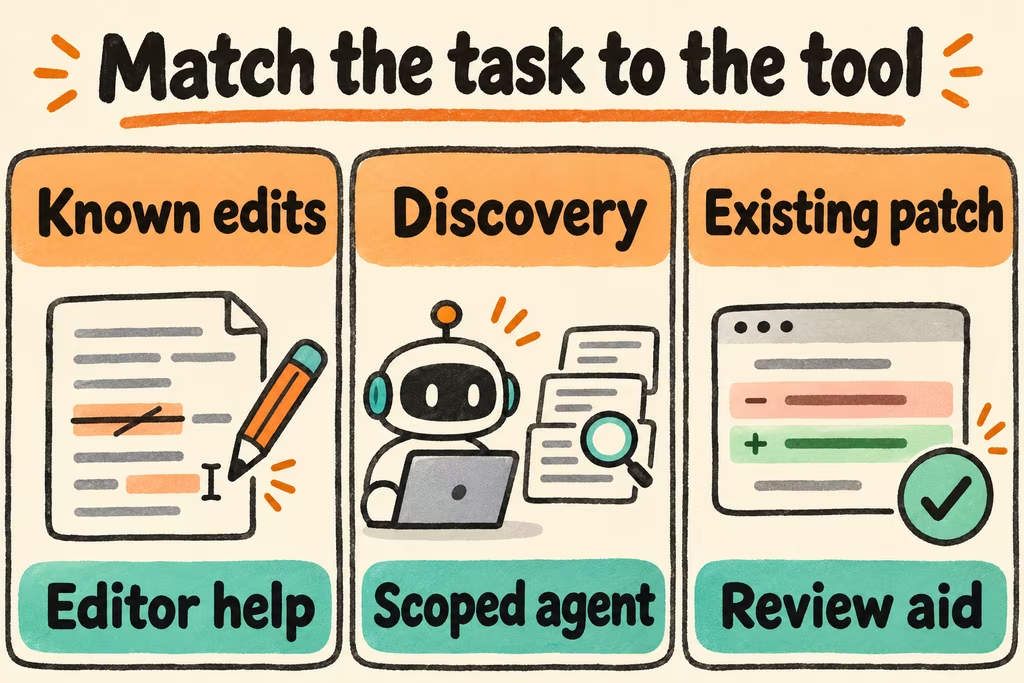
Start with the task you want to improve and the access it requires. Try editor help for known changes, a scoped repository agent for discovery and verification, and review assistance for existing patches. Choose a model and tool separately when the difference matters, and narrow the pilot to one team and one class of work.
Find a guide
Compare model families
- GPT-6 Models and Pricing: Choose Astra, Sol, Terra, or Luna
- Claude Models Compared: Haiku, Sonnet, Opus, and Fable
- Gemini Model Versions and Where to Use Them
- GPT-6 vs Claude for Coding and Analysis: Compare Exact Models
- Mistral vs DeepSeek for API Use and Self-Hosting
- Self-Hosted Mistral Models for Practical Inference
Choose a coding workflow
- Best Coding Agents for Terminal, IDE and Pull Request Work
- AI Agent Use Cases with Real-World Checks and Human Approval
- How to Use Google Antigravity: App, IDE, and CLI Tutorial
- Claude Code vs Aider for Terminal Coding and Git Review
- Self-Hosted AI: Choose a Local Model, Platform, and Assistant
Review and measure the output
- How to Review AI-Generated Code Before You Merge
- Coding Agent Benchmarks: From Leaderboards to Developer Productivity
Manage costs and troubleshoot
Choose the evaluation for your task
Use the coding tools and pair comparisons when you need a working flow inside your repository. Use the model comparisons to learn which version, price tier, and input formats your intended provider supports. A model release announcement gives you a candidate for a test. The research and case guides help you inspect data provenance and independent verification.
An internal AI pilot program needs an accountable point person, a budget, and baseline data. Record the end-to-end time through review and rework. Compare total cost per accepted result, which includes rejected attempts and reviewer effort.
| Goal | Where to start | What to collect |
|---|---|---|
| Edit a known area | Editor or Git-centered CLI | Interruptions, accepted diff, and review time |
| Investigate and deliver a change | Scoped repository agent, then a paired tool test | File discovery, tool permissions, acceptance tests, and rollback effort |
| Review AI-written code | Code review guide | Findings confirmed by a maintainer, misses, and false-positive review cost |
| Select a model release | Exact-model comparison and pricing guide | Version, effort, retries, tokens and quality at the deadline |
| Evaluate a research claim | Original study and its methodology | Date, participants, workload, baseline, and independent replication status |
How two HN reports change an internal pilot
In a discussion about more ambitious software projects, bob1029 said that team coordination could absorb time saved by individual developers. Include review, fixes, and integration time in the pilot with the people who normally do them.
In a separate Ask HN thread about shipping unfamiliar generated code, edwin0 raised the risk that implementation and tests written by the same model could miss the same issue. Include acceptance cases maintained outside the treatment workflow. Have a reviewer explain how they detect a regression without relying only on the patch's own assertions.
Run a limited AI pilot program
- Choose one team, one work class, and 12 to 20 representative approved tasks. Record expected outputs, first-week spend, turnaround, rejection reasons, and required access controls from the baseline.
- Assign comparable tasks between the current workflow and a single candidate. Keep acceptance tests and reviewer standards common. Record model, harness, permissions, training time, and exceptions.
- Track end-to-end time, accepted changes, repeat work, escaped issues, and spend. Ask reviewers to score difficulty before comparing outcomes so different workloads remain visible.
- Roll out only if the pilot improves the chosen endpoint without missed acceptance or access failures. Stop when scope, spend, or unresolved quality issues cross the agreed limit, and preserve the baseline and rejection notes for the next test.
AI model release timeline and availability
Use this timeline to route an evaluation. A publisher announcement, access for a given account, API availability, and a downloadable weight release can happen on different dates. The dates below describe specific public events. Confirm current access using the provider guide before scheduling a trial.
kibae shared the GPT-6 Astra launch on HN, opening a discussion about capability claims. bradleyg223 shared the Gemini 4 Argon announcement in a separate discussion. Google published developer availability in a follow-up. When documenting a candidate, record the date and the surface your team can actually use.
- Record the publisher, announcement date, precise model ID, and product surface for one candidate.
- Check the first-party catalogue for the access path, billing unit, and required account policy.
- Use a harmless fixture and the intended account to validate access and one minimum capability.
- Advance only after the exact model and allowed surface are confirmed. Defer if your policy disallows the available preview or your account cannot access a usable release.
| Date | Public event | What to verify for a trial |
|---|---|---|
| Sep 2026 | Anthropic introduces Claude Fable 5.1 and Claude Mythos 5.1 | Check the current model ID and account eligibility. |
| Sep 2026 | OpenAI introduces GPT-6 Astra | Check the model documentation for the chosen API or product surface. |
| 30 Sep 2026 | Google announces Gemini 4 Argon | Track product rollout separately from API access. |
| 6 Oct 2026 | Mistral announces the Mistral Large 4 public preview | Distinguish preview API access from the published weight artifact and license. |
| 13 Oct 2026 | Google publishes Gemini 4 Argon developer availability | Use the current catalogue for the exact ID and allowed deployment. |