 Knowledge Library
Decision in brief
Start with a known input collection and an auditable output. Use an editor assistant for direct edits and fixed rules for predictable routing. Try a bounded agent when the next read or draft depends on previous results, and require a person to approve consequential actions.
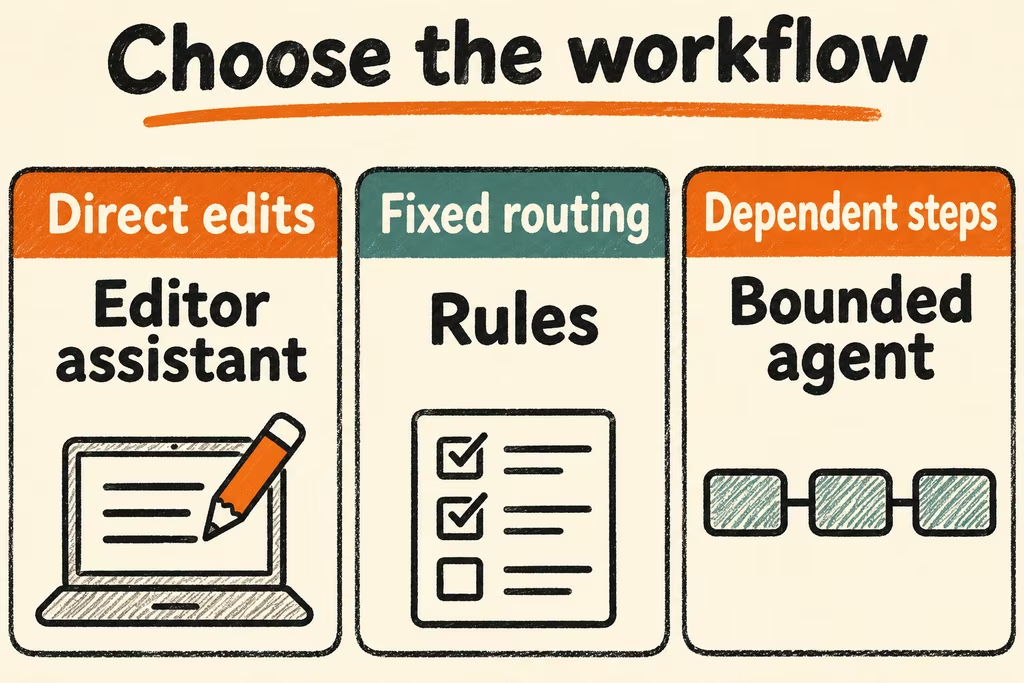
Choose an AI agent use case you can verify
A fixed workflow executes a defined sequence. An agent can decide which approved step to take based on results. Compare both routes on the same job and decide whether flexibility earns its extra calls, delay, and review burden.
Give a pilot a dedicated scope, a clear stop condition, and a way for a reviewer to see what it requested and why. Test only with approved documents and fixtures. Connectors may keep their own logs and permissions, so include them in the rollout check.
| Use case | First useful output | How to check it |
|---|---|---|
| Small implementation task | A reviewable patch in a disposable repository | Check the diff and repeat the named behavioral tests |
| Internal document research | A source-linked answer or an explicit request for a missing document | Verify citations and look for unsupported claims or out-of-scope access |
| Request processing | A routing suggestion or a draft reply for a human | Compare with labeled routes, count unnecessary escalations, and require approval before sending |
| Creative demonstration | A labeled mock-up derived from supplied material | Record input influence and judge the deliverable without treating it as a real forecast |
What real-world HN examples can establish
In an AgentRun Show HN, miguelrios described moving repeatable routing and evidence screening into declared workflows after inspecting traces. The post describes their workflow design. Use it to identify which of your own decisions already have clear rules and can be pulled into a fixed stage.
In an independent Show HN, keepamovin shared a Gemini-generated future front page and disclosed the present front page was supplied as input. The visible output is an example of a mock-up. The disclosed input lets a reviewer measure how much it reuses current topics and layout.
Run a bounded pilot before adding more permissions
- Pick one use case and 15 approved cases with expected outputs plus several cases where the correct next step is to ask for clarification. Keep the tool list and input scope in writing.
- Build a simple baseline with an editor assistant or fixed sequence. Run a second version with read-only agent steps using the same fixtures. Store each action request and response for review.
- Have a human check source attribution, delivered output, wrong tool requests, and total review minutes. Rehearse a false request to send or publish using a mock destination and verify it stays a draft.
- Advance only if the trial passes the chosen acceptance floor and every approval boundary stays intact. Stop after an unapproved access request, an action without review, or repeatable errors that erase the baseline's savings.