 Knowledge Library
Decision in brief
Start with Mistral Small 4 if you need a smaller deployment candidate or Apache 2.0 is a requirement. Use DeepSeek Flash as a hosted baseline when the first-party API and data terms fit. Add Mistral Large 4 only when harder tasks justify a larger deployment or its hosted endpoint proves more economical per accepted result.
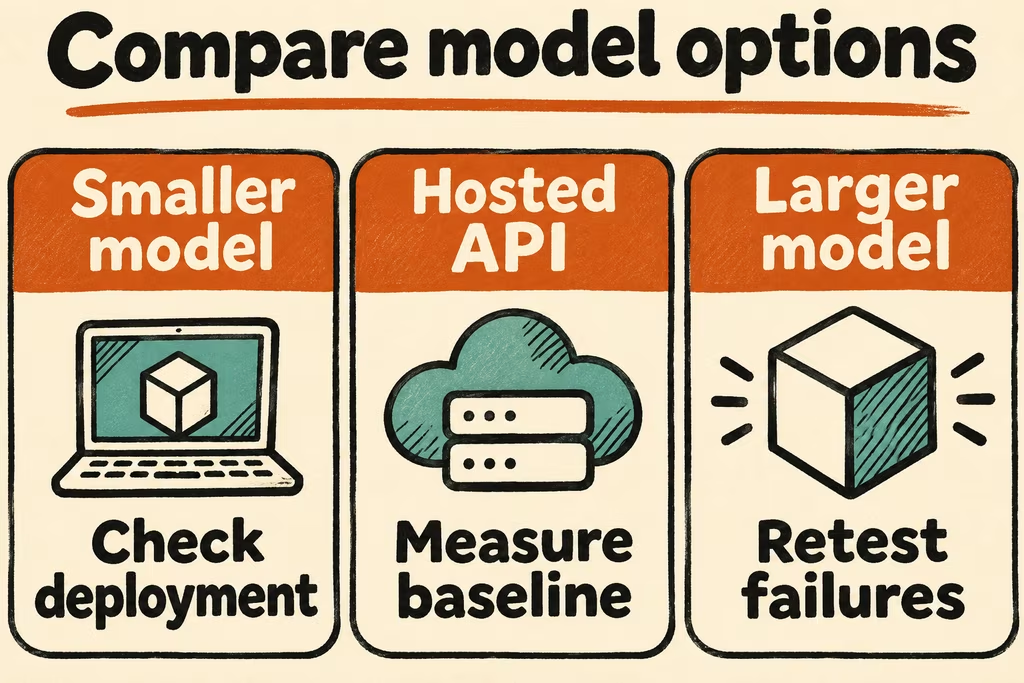
Which Mistral and DeepSeek deployments are comparable?
The current comparison uses Mistral Small 4 (mistral-small-2603), Mistral Large 4 (mistral-large-4), and DeepSeek V4.1 Flash-1017 (deepseek-flash on the first-party API). Their weight sizes and active parameter counts differ substantially. An API buyer can compare accepted output per billable dollar. A self-hosting team also needs to compare throughput and reliability within the same accelerator-memory budget.
Small 4 is listed under Apache 2.0. Large 4's release uses the Mistral Ecosystem Open Weight License v26.10. The DeepSeek model card lists MIT for Flash-1017. Read the license attached to the exact artifacts for your distribution or service model, including weights from forks and any serving components. The provider pricing pages are the source of record for hosted billing.
| Situation | Candidate | What decides |
|---|---|---|
| Smaller self-hosted deployment | Mistral Small 4 | Fits memory headroom at target concurrency and meets task quality |
| Large self-hosted deployment | DeepSeek Flash or Mistral Large 4 | Compare the actual compiled or quantized stack at the same memory and workload limit |
| Managed inference | A Mistral model and DeepSeek Flash through their APIs | Actual cost per accepted request, approved region, throughput, and fallback behavior |
| Required internal redistribution or service terms | The weights and runtime you can use for that purpose | An accountable reviewer confirms attached license terms and logs artifact versions |
What two HN reports suggest benchmarking
In the Mistral Large 4 weights thread, Surac described evaluating Mistral and Claude and said the coding harness and available skills shaped their experience. When comparing Mistral to DeepSeek, start with the same harness and keep separate notes on features supplied by its provider adapters.
In the separate DeepSeek Flash release discussion, swingboy asked whether local inference can differ from what a lab serves even when weights are available. Record the inference engine, template, and artifact revision and test the output contract in your own deployment.
Compare time, memory, and recovery on one workload
- Choose a fixture set with 15 to 30 approved examples, a response contract, and a quality floor. Define allowed hosts, maximum memory and a p95 latency target before selecting candidates.
- Run the same examples through both official APIs or two version-pinned local configurations. For a local pair, provision the same memory cap and record precision and concurrency, including cases where a model cannot fit.
- Measure cold and warm performance, total cost per accepted output, operator time, and tail latency. Restart a candidate in staging and measure how quickly the logged artifact and parameters restore prior behavior.
- Proceed only when the candidate fits the workload, meets the recovery goal, and has approved terms. Stop if an artifact cannot fit with room for concurrent requests, restore cannot be repeated, or a deployment rights question remains open.