 Knowledge Library
Decision in brief
Start with GPT-6 Luna for short extraction or routing. Try GPT-6.1 Terra for visual interpretation and writing, GPT-6.1 Sol for multi-file coding and analysis, and GPT-6 Astra for difficult failures worth revisiting at a higher budget. Treat an upgrade as a test of specific tasks and releases.
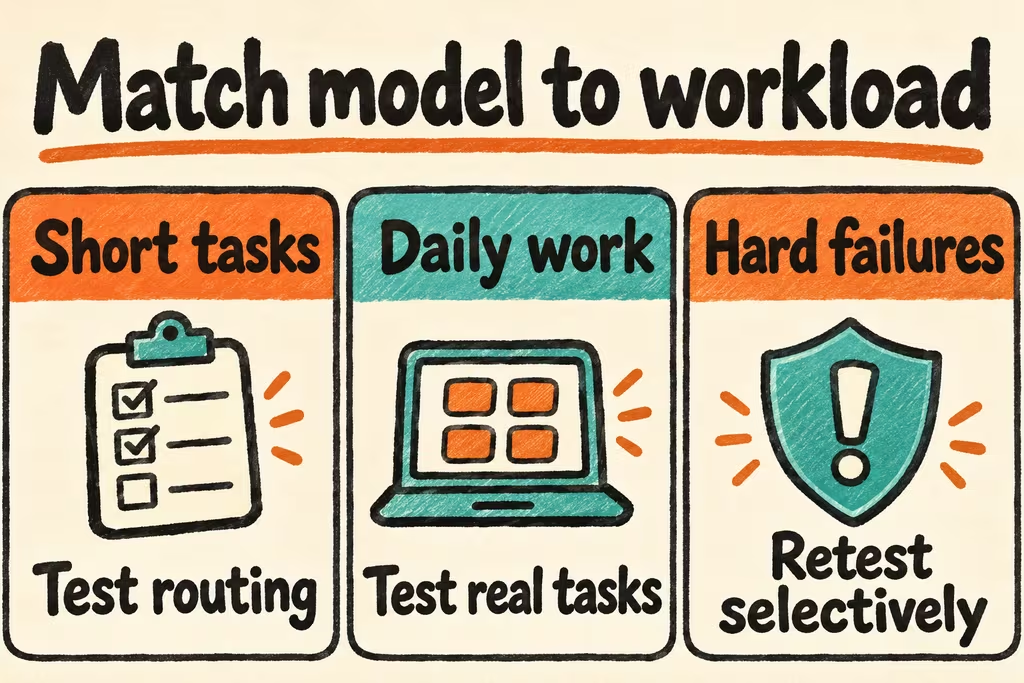
Choose the GPT-6 model for your workload
OpenAI's current GPT-6 guide leads with Astra, GPT-6.1 Sol, GPT-6.1 Terra, and Luna. Record the full API identifier in an eval and distinguish GPT-6.1 Sol from GPT-6 Sol when retesting an existing integration.
The table shows standard, short-context USD API rates per million uncached input and output tokens checked on November 17, 2026. Cached reads, cache writes, long prompts, service speed tiers, regional processing, and tool fees can change your total. Check account availability separately for the API and for a subscription.
| First candidate | API model ID | USD input / output | What to measure |
|---|---|---|---|
| Luna | gpt-6-luna | $0.10 / $0.50 | Schema validity and missed fields on high-volume extraction |
| GPT-6.1 Terra | gpt-6.1-terra | $1 / $5 | Visual field interpretation, writing edits, and time to acceptance |
| GPT-6.1 Sol | gpt-6.1-sol | $2 / $10 | Multi-file test results, review time, and latency |
| Astra | gpt-6-astra | $10 / $50 | Specific failures resolved after cheaper options miss the acceptance gate |
How GPT-6 pricing changes the routing decision
A 10,000-token uncached input and 2,000-token output cost $0.04 on GPT-6.1 Sol and $0.20 on Astra at the table rates. This is an arithmetic example with matching token counts. Different models may consume different numbers of tokens or retries to complete the same task.
For GPT-6.1 Sol, OpenAI documents 2× input and cache rates and 1.5× output rates for the full API request above 272,000 input tokens. Size the prompt with real retrieval, tool definitions, and conversation history included before using a short-context estimate.
Two HN observations to turn into tests
In the GPT-6.1 Sol release discussion, XCSme shared a hamster-rendering comparison and judged Sol close to Astra on that example. Visual resemblance is a narrow outcome. Add your own difficult inputs and define a scoring rule before seeing the model output.
In a separate Terra discussion, desireco42 liked Terra for tasks previously given to Sol or Astra and described using Luna for prototype implementation. Use the report to test a deliberate split between low-cost routine work and more demanding review, with failure and review time measured for both.
Run a routing trial before changing your default
- Sample 20 approved tasks across your real workload mix. Record the expected answer or test output, deadline, review budget, and an upper spend limit.
- Run the most suitable lower-cost candidate and a stronger candidate on matching inputs. Pin the model ID or snapshot, effort, context and output budgets, and available tools. Retain the old configuration as a fallback.
- Have a reviewer score anonymized outputs. Separately log rejected attempts, review minutes, total tokens billed, and response time. For each model, divide spend across all attempts by accepted results.
- Promote only if the candidate meets the agreed quality and latency floors without increasing review burden. Stop at the spend cap, unexpected access, or a recurring failure that the fallback also misses.
GPT-5 vs GPT-6 and when an upgrade passes the test
Start with the exact model and endpoint in use. For a workload on GPT-5.6 Sol, test gpt-5.6-sol against gpt-6.1-sol on the same accepted tasks. A workload using the original gpt-5 API model has a different scheduling constraint. The deprecation table checked November 17, 2026 lists its shutdown for December 11, 2026 and recommends gpt-6.1-sol. Record the date for your own model ID and keep a fallback that still accepts requests when you need it.
OpenAI documents Responses as the tool-calling API for GPT-6.1 Sol. It supports low reasoning effort as its minimum setting. If your current workload uses function calls through Chat Completions or uses none for reasoning effort, test those compatibility changes explicitly. The model pages showed $4 input and $20 output per million text tokens for GPT-5.6 Sol and $2 input and $10 output for GPT-6.1 Sol at standard context on November 17, 2026. The GPT-5.6 Sol page labels its rate promotional through November 30. Recompute from billed usage and the applicable price tier before choosing.
In a GPT-5.6 Luna and GPT-6 Astra code-review discussion, verdverm explained how several review sessions and context gathering changed the cost of a cheaper model. In a separate HN thread, simonw explained that an independent parser test suite made the results of a GPT-5.2 port checkable. Use those cases to count the whole workflow and to verify behavior against tests whose expected results were fixed in advance.
- Record the baseline model ID, endpoint, effort setting, tool permissions, baseline cost and the fallback date. Choose a representative set of approved tasks with pass criteria and a fixed spend cap.
- Run the baseline and candidate on identical inputs with the nearest supported reasoning settings. Test compatibility changes in isolation where possible. Save billed inputs, output, retries, tool calls and reviewer time.
- Compare both sides blindly on the same checks. Count total run cost, including failures and retries, divided by accepted tasks. Separately review the hardest failures and whether a supported fallback succeeds.
- Release to a small approved cohort only when quality, latency, access and cost satisfy the written limits. Pause on a failed required check or unavailable fallback and restore a supported baseline.
| Workload | Acceptance measure | Pause when |
|---|---|---|
| Structured response used by another service | Schema validity and exact required fields | A critical field becomes invalid or omitted |
| Benign coding or document review | Independently verified useful results, reviewer minutes and cost per accepted task | The trial misses a required check or exceeds its spend cap |
| Tool-assisted job | Approved tool sequence, p95 latency and recovery after an ordinary timeout | A tool moves outside its allowed scope or recovery depends on a retiring endpoint |