 Knowledge Library
Decision in brief
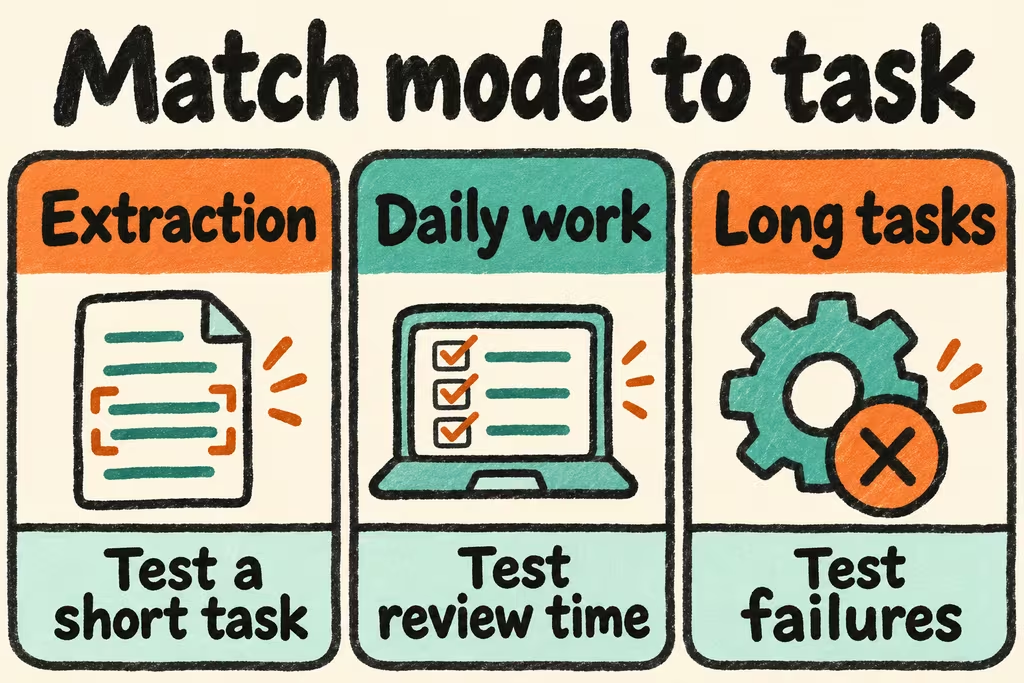
Start with Haiku 5.5 for repeatable extraction and routing, Sonnet 5.5 for routine coding or document work, and Opus 5.5 for longer tasks with more dependencies. Add Fable 5.2 to the trial when difficult tasks still fail on Opus and a better result would justify the extra cost. Let verified outcomes and response time determine your default.
Compare the current Claude models for your task
Anthropic lists these four as its latest general-use models as of November 17, 2026. Their Claude API listings show a 1 million token context window and a maximum of 128,000 output tokens. Check your provider, endpoint, and account before sizing a deployment around those limits. For a short request, evaluate completion time and correctness on the actual task.
The table uses standard first-party Claude API USD rates per million input and output tokens. For example, an uncached request with 10,000 input tokens and 2,000 output tokens costs about $0.04 on Sonnet and $0.08 on Opus at those rates, before retries and any tool charges. Cache usage, batch processing, Fast mode, or provider pricing can change the calculation.
| Model | Standard API price per million in / out | First workload to test | Evidence to collect |
|---|---|---|---|
| Haiku 5.5 | $0.10 / $0.50 through 100,000 prompt tokens. $0.50 / $2.50 above. | Extraction, routing, and short classifications | Rate of valid results, field accuracy, and latency by prompt size |
| Sonnet 5.5 | $2 / $10 | Small code changes and recurring document tasks | Time to a verified result and human correction time |
| Opus 5.5 | $4 / $20 | Multi-file changes or extended analysis | Accepted results and total review time across longer tasks |
| Fable 5.2 | $8 / $40 | Costly reasoning failures that survive an Opus trial | Which specific failures disappear, and what each recovered case costs |
Check access before budgeting
A Claude model is available through particular products and providers. Claude Code is the tool that applies a selected model to coding tasks. When testing in Claude Code, record the model plus the tool settings and exact access path. For the API, record the model ID and your provider’s billing meter. For subscriptions, check the model selector, seat, usage window, and admin settings.
Anthropic's Fable plan guide says standard access varies by paid plan and seat. Pro and standard Team seats ordinarily use usage credits for Fable, while Max and Ultra have a Fable share of their weekly allowance. Read the guide for seat-specific rules and temporary offers. Mythos 5.2 has limited access for approved partners. Keep it out of a purchase shortlist unless you already have documented access.
Two HN cases that change the test
In the Fable 5.1 release discussion, simonw varied the model's effort on the same drawing task. The highest setting took substantially longer and used many output tokens in that run. Record the effort setting, and test a representative request with a fixed deadline before making a slower setting the default.
In the separate Opus 5.5 discussion, senko posted outputs from browser-game prototypes to compare multiple models. Public examples make differences inspectable, while prototype quality covers only one kind of work. Include a task with your actual maintenance constraints and count the time a reviewer needs to decide whether to ship it.
Run a paired Claude model trial
- Choose 12 to 20 representative, approved cases with expected results. Include simple successes and difficult failures. Set the acceptance rate, latency target, and spend cap before running them.
- Run two available models on matching inputs through the same tool and provider. Pin the model IDs, effort, permissions, and input boundaries. Add a longer prompt if your application regularly approaches the Haiku prompt threshold.
- Have a reviewer score outputs without seeing the model name. Record accepted results, retries, review minutes, response time, and billed usage. Divide the cost of all attempts and review by the number accepted.
- Promote the lowest-cost configuration that meets quality, latency, and data-access requirements. Route a narrow group of repeatable failures to a stronger configuration if its gains justify the difference. Stop on budget overrun, unexpected data access, or unrepeatable improvements.