 Knowledge Library
Decision in brief
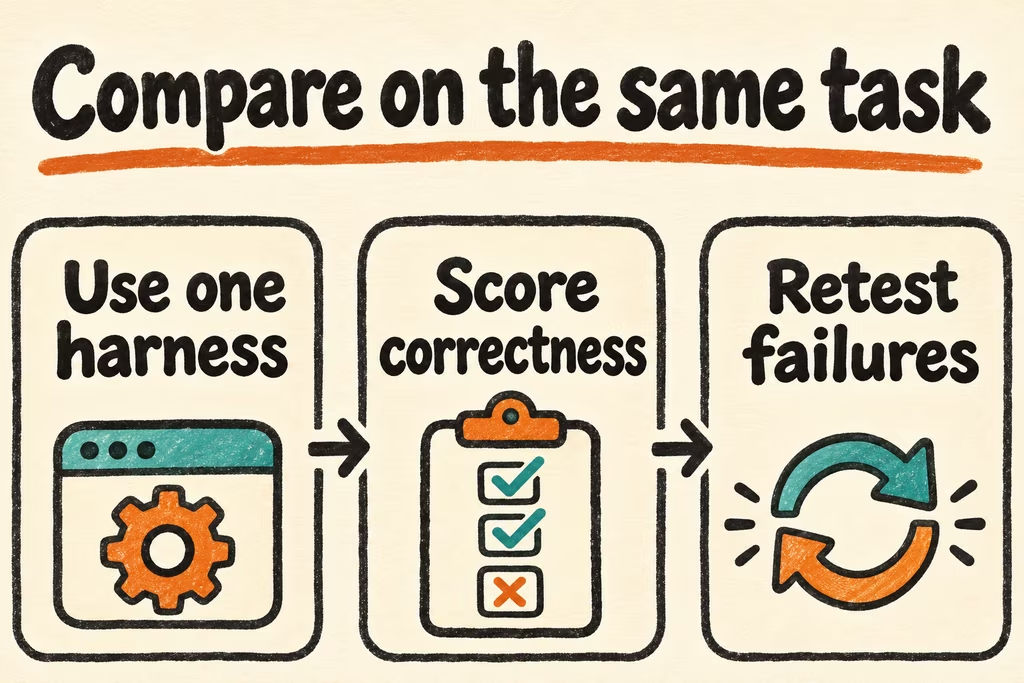
For routine coding and analysis, first test GPT-6.1 Sol and Claude Sonnet 5.5 through the same harness. For unresolved reasoning or long tasks, add GPT-6 Astra and Claude Fable 5.2 on the failures. Choose the lowest total cost that meets required correctness, access, and response time.
Choose a comparable GPT-6 and Claude pair
GPT-6 and Claude name families. A Codex or Claude Code session also has a harness that selects tools, applies permissions, and manages context. A model-only test and an installed-tool test answer different questions. Run each separately if both affect the decision.
In USD per million uncached input and output tokens, official standard first-party API pricing checked on November 17, 2026 lists GPT-6.1 Sol and Claude Sonnet 5.5 at $2 / $10 each, GPT-6 Astra at $10 / $50, and Claude Fable 5.2 at $8 / $40. The OpenAI rates shown are short-context rates. Compare actual input and output counts, caching, tier adjustments, and the cost of failures before interpreting those prices.
| Workload | OpenAI candidate | Anthropic candidate | Acceptance signal |
|---|---|---|---|
| Routine multi-file change | gpt-6.1-sol | claude-sonnet-5-5 | Behavior checks pass, diff stays scoped, reviewer time fits budget |
| Hard reasoning or diagnosis | gpt-6-astra | claude-fable-5-2 | Correct result survives independent verification within the deadline |
| Cost-sensitive easy cases | gpt-6-luna | claude-haiku-5-5 | Structured result and field accuracy meet the floor |
| Full coding workflow | Codex in its approved configuration | Claude Code in its approved configuration | A teammate reproduces the tests, reviews the diff, and can roll back |
What HN examples tell you to control
In the GPT-6 Astra release thread, intenex questioned whether a benchmark comparison used equivalent harness behavior for both generations. Make tool access, attempt budgets, and scoring explicit when you can hold them common. For necessary provider-specific features, measure the complete configuration separately.
In the Claude Opus 5.5 discussion, aurareturn reported repeatedly choosing Fable and wondered how much reflected familiarity with its style. Hide model names while scoring correctness. If style matters for your work, record it as its own criterion.
Run a paired comparison on the same inputs
- Take twelve approved fixtures from one task class. Give each an expected result, deadline, and cost cap. Keep difficult failures separate from the routine set.
- Run each model on the same fixture with equivalent tools and effort or token budgets as far as the interfaces permit. Record snapshots, retries, cached inputs, and any differences in capability.
- Have a reviewer judge outputs without labels. Count corrected results, hands-on minutes, and total billed cost per accepted result. Verify data access and provenance before comparing speed.
- Adopt a default only when it meets the same correctness and access floor. Escalate failed cases to higher-priced models only if the added accepted results offset the cost. Stop when a candidate reaches the cap or shows a repeated critical failure.