 Knowledge Library
Decision in brief
Shortlist a tool by where the work starts and where it must be approved. Trial Cursor or Copilot for developer-driven editor tasks, Claude Code or Codex for terminal work, and a dedicated cloud agent for branches with reproducible CI. Choose a provider-flexible client such as OpenCode when changing model backends matters enough to operate the credentials and budgets yourself.
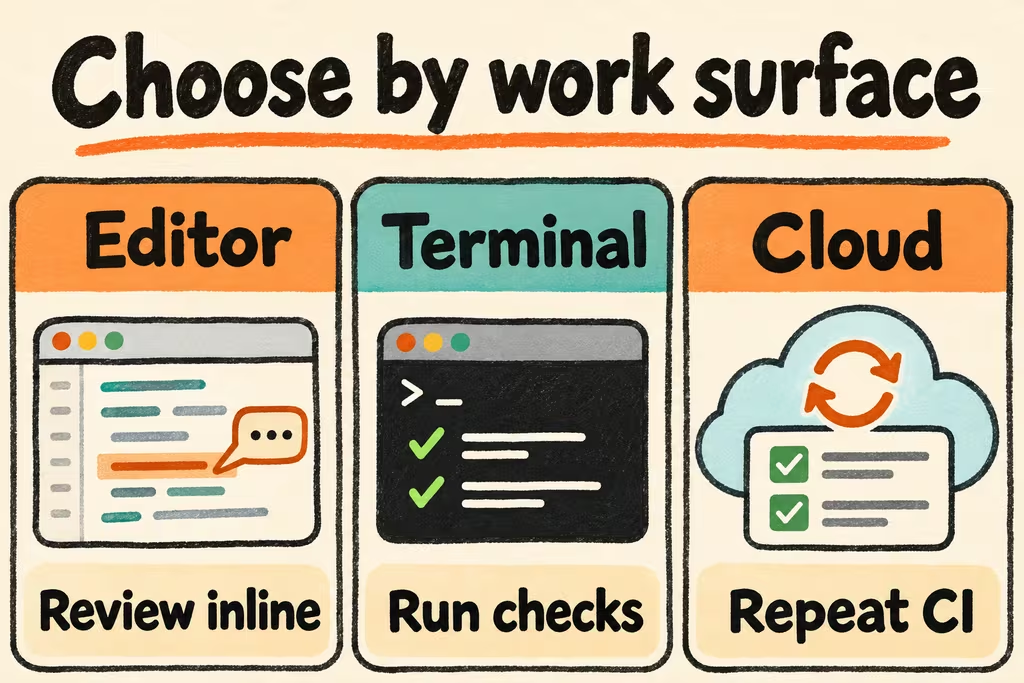
Best coding agent by use case
The client and model jointly determine behavior. The client selects context, runs tools, handles credentials and exposes approvals. A model name on two product menus does not imply equal context, commands or cost. Lock down required integrations and data handling before testing which tool writes the better patch.
| Workflow | Example shortlist | Acceptance condition |
|---|---|---|
| Interactive work in an existing editor | Copilot or Cursor where the editor is approved | Can explain or repair a cross-file change without disrupting debugging. |
| Terminal-led work with explicit test commands | Claude Code or Codex CLI | Can run the team’s existing tooling and present the resulting diff for review. |
| Background issue to pull request | Copilot cloud agent or Codex Cloud | Reproducible setup and a policy-compliant handoff with required checks. |
| Provider portability or local inference | OpenCode with an approved backend | Supports required tools and context for that model and stays within assigned spend. |
Evaluate downstream effort and cost
Define output as a patch a maintainer would accept. Review time includes reading the diff, repairing tests and addressing comments, whether or not the agent succeeded. Keep subscription or platform charges and provider billing on separate lines. Use the exact plan and configured model to verify which limits or billing units apply. For cloud assignments count setup, queue and CI time separately from developer time.
What two Hacker News discussions add
In the HarnessTax thread, nojs described a trade-off they observed between token efficiency and handling mundane tool or edit failures. Treat their preference as a reason to track repeated calls and editing mistakes alongside tokens. It cannot establish a winner across all models.
In the discussion of Linear’s CI changes, aliclark reported that hands-on validation by people was their bottleneck. Linear itself describes addressing pipeline throughput. Ask your test team where patches actually wait before spending time optimizing generation.
Pick two workflow finalists
This is a rollout decision. Use a manual baseline and choose two tools suitable for the same team conditions.
- Select a bug fix, cross-file refactor, feature change and tests-only addition in an approved copy. Write exact acceptance checks and a maximum review and spend budget beforehand.
- Run your shortlist with consistent time limits and clean branches. Record client, version, model, tool approvals, first-pass checks and reasons for stopping. Keep local and cloud workflow results separate.
- Have a maintainer blindly rate the patches. Compare accepted work and discarded output against the manual baseline. Drop any tool that fails required permission, accessibility or data controls even if its patch passes.
- Adopt a secondary tool only if it clearly improves a distinct workflow and its extra setup, permissions and billing are justified.