 Knowledge Library
Decision in brief
Choose Tailscale when you need to enroll and remove people and devices, apply centrally managed access rules, or connect roaming clients through changing networks. Choose manually configured WireGuard for a small set of stable peers or gateways if you can manage keys, routes, endpoints and recovery yourself. Tailscale uses WireGuard for encrypted device traffic and supplies coordination around it.
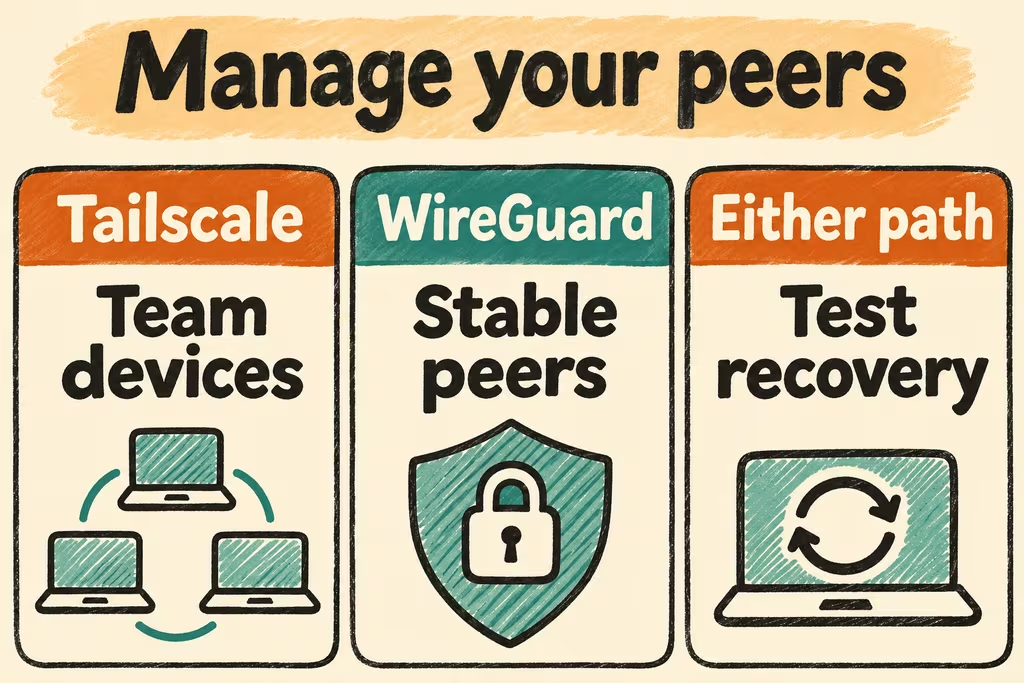
Tailscale vs WireGuard differences by operating responsibility
WireGuard pairs peers using public keys and associates allowed address ranges with those peers. With a manual deployment you choose how to distribute configurations, keep endpoints reachable and enforce additional traffic restrictions. Tailscale manages device discovery and connection coordination, and applies policies for who can reach which resources.
Separate the data path from the control plane. Tailscale can establish a direct connection between peers. When conditions prevent that, it can use a configured peer relay or its DERP relay service. A connection through a relay can still work while having different latency or throughput. Record connection type before comparing performance.
A site-to-site tunnel between stable gateways is a different workload from staff reaching one service from laptops and phones. Compare operator time for key replacement, failed enrollment and route changes alongside connectivity.
| Decision | Tailscale | Manually configured WireGuard |
|---|---|---|
| Who can reach a service? | Define access with centrally administered identity and network rules | Manage peer keys and address ranges, then enforce service access with firewall rules and application authentication |
| How do roaming devices reach peers? | Coordination seeks a direct path and supports relayed connections | Design a reachable endpoint or gateway and maintain its routing and endpoint settings |
| Who handles policy, keys and changes? | The platform handles coordination while your team owns account lifecycle and policy | Your team owns peer configuration, enrollment, removal and route changes |
| Which implementation fits? | Several roaming devices and frequent access changes | A small set of stable endpoints with a capable network operator |
What HN operators reported about endpoints and coordination
MayeulC described a VPS and multiple physical servers connected by WireGuard, alongside a plan to move their Headscale node to the VPS for better availability after a residential outage. This is a concrete mixed setup. It demonstrates the value of specifying what should remain available when the home connection fails.
In another thread, ottah reported that their DIY WireGuard setup worked but that a changing residential IP complicated the setup. They were considering a self-hosted service reachable through a VPS because it better fit their preferences about who operates coordination. The comment does not establish what caused the reported ISP behavior.
In a discussion of another WireGuard-based overlay, edentrey described using a custom name server and a Caddy proxy within their Tailscale network. They chose to keep those application endpoints private. This illustrates how name resolution, app routing and exposure remain separate choices after the devices can reach each other.
When to choose Tailscale over WireGuard
Use the same two devices, one disposable application and the same test networks for both candidates. A roaming laptop and a service host behind a home router reveal different tradeoffs than two servers with stable addresses. Write down the highest acceptable delay in adding or removing a device before starting.
- Create a dedicated test group and a service that accepts a harmless request. Document which device may reach which port. Retain an independent admin path during the trial.
- Measure time to enroll a fresh device and confirm it can reach the intended application. Repeat from your supported home Wi-Fi and mobile or office network. Record application success, latency, and for Tailscale whether the connection is direct or relayed.
- Revoke the test identity or peer and verify that it loses access. Confirm an authorized device can still reach the service. Rehearse recovery after changing the roaming network or a gateway address.
- Choose the option that meets enrollment, revocation and service requirements with a repeatable runbook. If peak throughput matters, compare the observed relay and direct paths separately on your own networks.