 Knowledge Library
Decision in brief
Run a private filter such as Pi-hole if you mainly want blocklists and local names. Add a private recursive resolver like Unbound if you want to operate caching and validation directly. Keep managed authoritative DNS for public domains unless you can operate redundant authoritative servers and rehearse delegation changes.
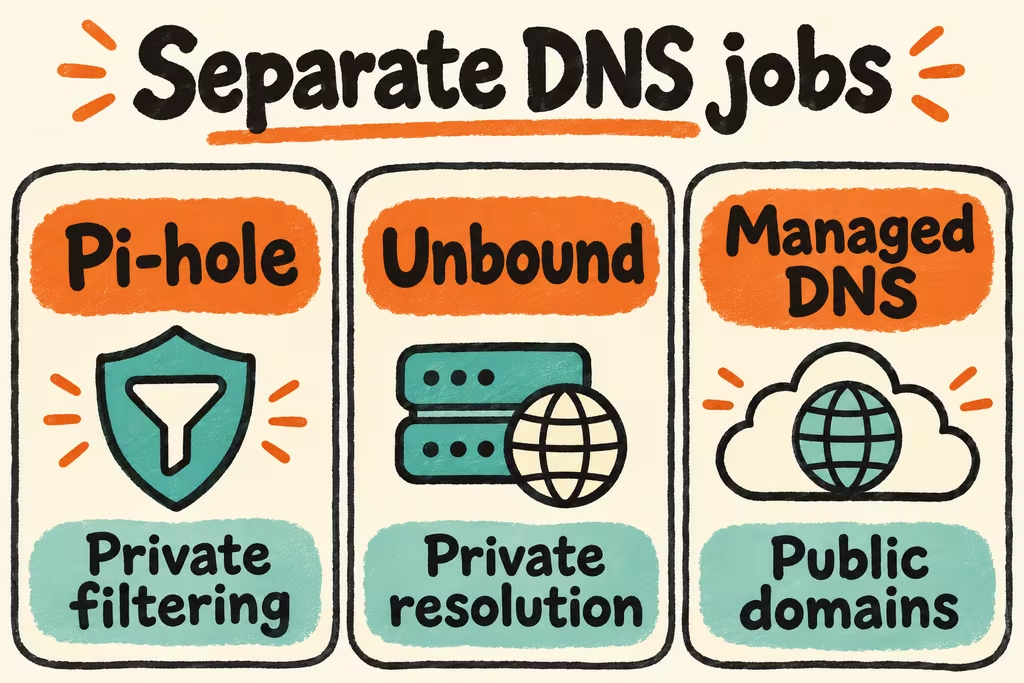
Select the DNS role before installing software
A client asks a recursive resolver for answers. That resolver can forward upstream or query the DNS hierarchy itself and cache answers. Pi-hole can apply filtering locally and send permitted queries to an upstream such as Unbound. Expose recursion only to approved clients and networks. Document how remote and mobile clients reach that private service and how their normal resolver settings interact with it.
Authoritative servers such as NSD answer for zones they serve. For an internet domain, test all delegated nameservers, the intended DNSSEC setup, and the path for correcting a record out of band. Keep public authority and private recursion separate. For private split DNS, test that every intended client gets the correct local answer without publishing private records.
| Job | Starting setup | What must survive |
|---|---|---|
| Home LAN filtering and local names | Pi-hole using a trusted upstream resolver | Blocked and allowed fixtures behave as intended on IPv4 and IPv6. A failed node has a documented fallback. |
| Private recursive resolution | Unbound with recursion and validation on the trusted network | Cached and uncached responses match the expected fixture, and unapproved clients cannot use recursion. |
| Public authoritative DNS for a domain | Managed authority or redundant NSD servers in separate fault domains | Every nameserver serves the expected zone and serial, with verified secondary updates and a registrar recovery path. |
HN examples at both sides of the DNS decision
nxvalue described a private DNS deployment with Pi-hole or AdGuard Home in front of Unbound and encrypted client endpoints. For a similar deployment, separate the test for endpoint connectivity from the tests for filtering, local answers, and validation on the actual devices.
In a separate authoritative hosting discussion, ralferoo asked what would make Knot preferable to a familiar BIND installation. Include the staff's emergency update and recovery skills when comparing authoritative software. A zone reload that only one person can perform is a deployment dependency.
Pilot with one device and a test zone
- Record the current router or device resolver settings and keep their rollback instructions offline. Point one device you own at the test resolver. Use one allowed public name, one local record in a test zone, and a controlled blocklist fixture.
- Test normal resolution, local names, and the filter from each intended device type and protocol. Take the test resolver offline and measure return to normal resolution using the documented fallback. Check that fallback still meets your filtering policy if that policy is required during outages.
- If authoritative service is in scope, delegate only a disposable domain or subdomain you control. Verify records and zone serials at each intended server. Make a test update, confirm secondary convergence, and verify the correct answer with the test primary unavailable.
- Roll out only when allowed and blocked fixtures pass, recursion is limited to approved clients, and the recovery path meets the agreed time. Stop if an authoritative server serves stale records outside the test window, or if client settings silently bypass required filtering.