 Knowledge Library
Decision in brief
Use Docker to build and run containers. Use Docker Compose when one host can meet your service's availability and recovery targets. Consider Kubernetes when you need workloads to move between hosts, multiple teams need a common deployment platform, or application rollouts require automated coordination. Keep your Docker build workflow if it already produces suitable container images.
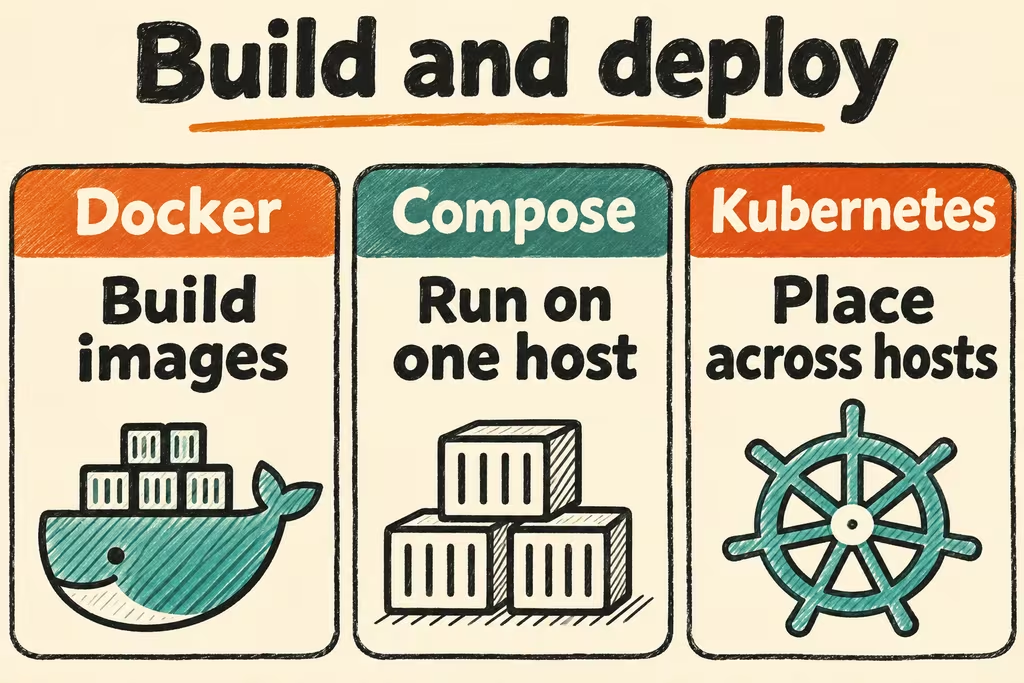
Kubernetes vs Docker, Docker Engine and Compose
Docker Engine runs containers on a host. Docker Compose describes a multi-container application as services, networks, volumes and other resources, and its CLI manages that application. Kubernetes schedules containerized workloads across nodes and reconciles their declared state. Docker can build the images your Kubernetes cluster deploys.
Kubernetes removed its built-in dockershim integration in version 1.24. Nodes need a Container Runtime Interface implementation, such as containerd or CRI-O. The change affects node setup and operational tooling. An existing Docker image build does not depend on dockershim.
The practical comparison is single-host Docker Compose vs Kubernetes or another deployment platform. A cluster can reschedule replaceable workloads if it has healthy capacity. Keeping a database available and recoverable also depends on the storage, replication, backup and restore design.
| Requirement | Single-host Docker Compose | Kubernetes |
|---|---|---|
| Deploy an API, worker and background job | One application definition with a short runbook for the host | Workload resources and controllers with cluster-level configuration |
| Recover from a crashed process or a lost host | Restart on the same host, or rebuild and restore on another host | Replace Pods on healthy nodes where scheduling and storage allow |
| Update a frontend with minimal interruption | Coordinate replicas, proxy switching and health checks in the deployment procedure | Use Deployment rollout behavior and readiness checks, backed by capacity and compatible application changes |
| Keep durable state | Own volume backups, off-host copies and tested restore | Choose persistent storage and rehearse database recovery separately |
| Operate the deployment | Own the host, proxy, logs, updates and restore | Also assign owners for cluster upgrades, networking, ingress and workload policies |
Three deployment choices from Hacker News
In a self-hosting thread, steezeburger reported using Docker Compose locally, in QA and behind Nginx in production. They reuse the container images when the production target changes. Their practice suggests keeping packaging stable while revisiting deployment only when the service has a concrete reason to move.
On an NixOS Kubernetes write-up, sshine described using kind on Docker for development and preferring a simpler maintenance model on personal servers. Production and a local cluster were separate decisions for that operator. If the actual goal is to learn the Kubernetes API or exercise manifests, a local cluster is enough to test that need.
In the Docker image store discussion, jillesvangurp reported that Docker and Compose commands under Colima fit their local workflow and that its cluster support went unused. This case is about developer setup. It gives no estimate of availability or production support.
Test the upgrade from single-host Compose to Kubernetes
Choose an availability target, a maximum recovery time and a maximum acceptable data loss before testing. For example, accept a 30-minute host restore and at most 15 minutes of lost writes for one internal tool. Treat those numbers as an example and replace them with your team's actual requirements.
- On staging, record the image digest, restore commands, health probe and the last usable backup. Replace the process, then rehearse total host loss on a clean host. Measure elapsed time through a successful end-to-end request and check the latest recovered application record.
- Rehearse updating and rolling back a stateless version from the same image pipeline. Test from outside the host for failed requests and include any database schema transition in the rollback plan.
- If host loss or rollout behavior misses the objective, pilot one stateless service on a cluster with spare capacity and replicas on separate nodes. Simulate a node loss and repeat the same service checks. Leave the database on its validated platform during this test.
- Keep Compose if the restore and rollout results meet the agreed objectives. Move a service to the cluster when the pilot passes the missed objective and the team can repeat the recovery without relying on any one operator.