 Knowledge Library
Decision in brief
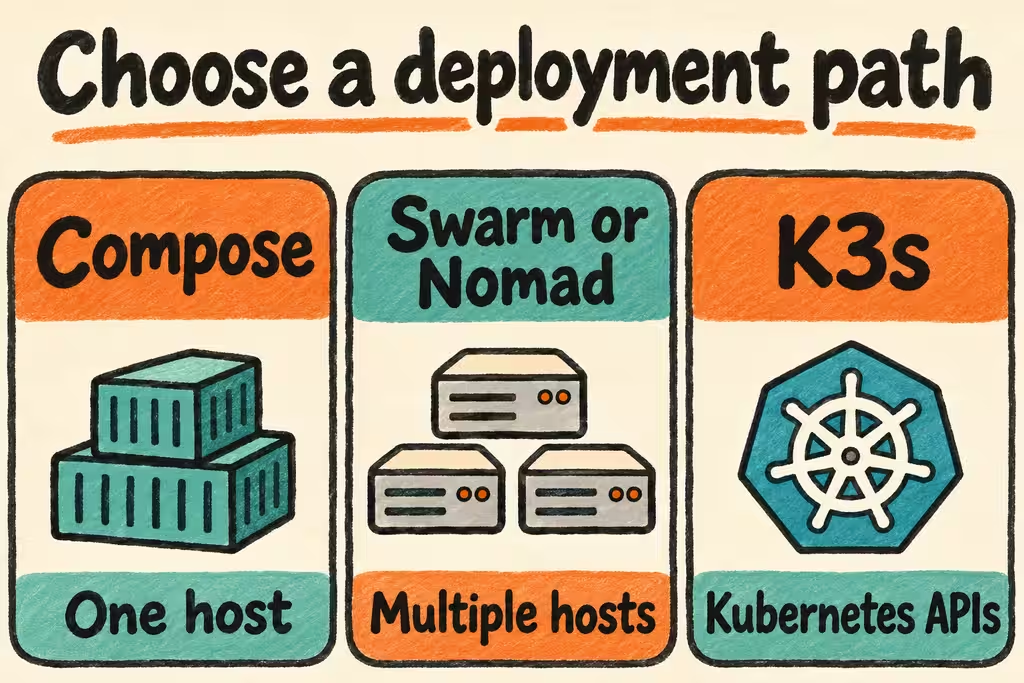
Start with Docker Compose when one server and a tested restore meet your availability target. Shortlist Docker Swarm for multi-node scheduling around Docker services, or Nomad for a mixed fleet of containers and other task types. Choose K3s when you still need Kubernetes APIs, Helm charts or operators but want a smaller distribution to manage. If managed Kubernetes matches existing tooling and removes the work your team struggles with, include it in the trial.
Best Kubernetes alternatives for Docker workloads
List the infrastructure failures the application must tolerate and how much downtime and data loss the business can accept. This distinguishes a straightforward single-host deployment from a workload that needs automatic rescheduling across hosts, replicated state or a managed control plane. Then list the Kubernetes APIs and controllers your workload assumes, including custom resources, ingress, storage and identity integration.
Compose runs a multi-container Docker application on a host. Swarm schedules Docker services across nodes. Nomad schedules workloads through task drivers, including containerized and non-containerized jobs. K3s packages Kubernetes in a lightweight distribution and retains Kubernetes capabilities and day-two responsibilities. Evaluate supporting components and licensing for the versions you plan to deploy.
| Option | Choose when | Price into the decision |
|---|---|---|
| Docker Compose | A single host plus a practiced restore meets your availability target | Host replacement, data recovery, TLS and your release and rollback procedures. |
| Docker Swarm | You need multi-node Docker service scheduling with an Engine-based workflow | Manager quorum, persistent volume placement, multi-host networking and recovery. |
| Nomad | You need clustered scheduling across container and non-container jobs | Job conversion, service discovery, identity, secret management and networking. |
| K3s or managed Kubernetes | You still need Kubernetes APIs, controllers and tooling | Cluster upgrades and application operations. For K3s, include datastore recovery and control plane ownership. |
What HN operators used to make the trade-off
In the Docker Swarm versus Kubernetes discussion, raffraffraff described combining K3s and FluxCD to deploy from a Git change with DNS and TLS updates. Inventory which automation a replacement must preserve and count how many steps the team would need to rebuild.
In a separate Docker Compose deployment thread, amluto highlighted draining requests during shutdown and the risk that an automatic retry can repeat a state-changing request. Verify application behavior during release and rollback on each candidate platform using a disposable workload.
Benchmark deployment, rollback, and host recovery
Use a staging copy with a web tier, a background worker and a small synthetic data store. Compare the same architecture on the two options that pass your availability and API filters. Use your availability target as the pass condition.
- Record the current deploy steps, time to roll back, measured outage and total monthly infrastructure cost. List the Kubernetes dependencies you would need to replace.
- Ship one test release while generating typical staging traffic. Measure error rate and check for duplicate writes. Roll the release back and repeat with a deliberately failing health check.
- Restart or replace a disposable worker host. Measure time until the service accepts traffic again and verify the synthetic data expected after recovery. Judge stateless rescheduling and stateful recovery independently.
- Ask a second operator to read the runbook and repeat the restore. Select the platform that passes service objectives with the smallest sustained burden for your team.