 Knowledge Library
Decision in brief
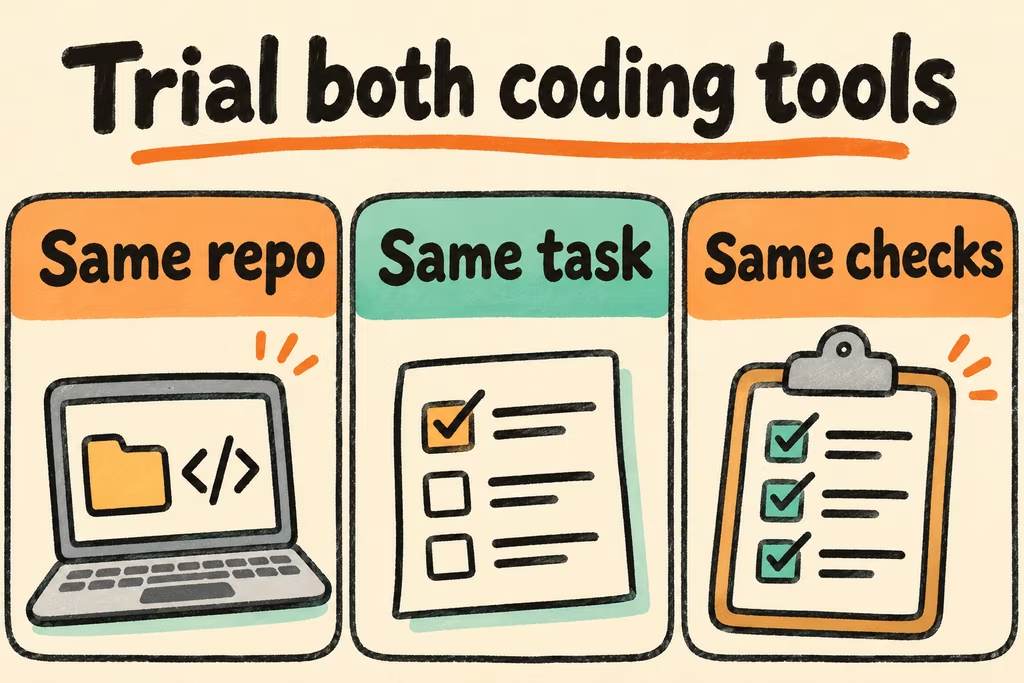
For local coding, run both on the same repository before buying a second plan. Start with Codex if your team already pays for ChatGPT and wants to test its cloud or review workflow. Start with Claude Code if your team already runs terminal-based review and uses Claude project instructions. Keep both in the trial if they solve different bottlenecks, such as editing latency and independent review.
Choose by task and execution environment
Both tools can participate in a repository workflow. Compare the local tools first if tests require local services or dependencies that are hard to reproduce. For hosted jobs, test environment setup, the exact network policy, access to the repository, and handoff to review separately. Record the client, model, and execution environment with each result.
| Workload | What to compare |
|---|---|
| One-file fix | Time to a passing targeted test and how many unnecessary files the assistant touched. |
| Multi-file feature | Whether the plan names the right modules and whether the resulting diff preserves existing behavior. |
| Long-running job | Environment setup, stop conditions, whether you can reproduce the checks locally, and the time to a reviewable patch. |
| Code review | True regressions caught, false positives, and review minutes. Use the same known-good and known-bad patches for both. |
Codex vs Claude Code pricing and limits
On November 16, 2026, OpenAI listed ChatGPT Plus at $20 per month. Anthropic listed Claude Pro at $20 monthly or $200 annually. Compare the plans on the surface you actually use. OpenAI publishes workload-dependent local-message estimates for eligible plans, while Claude publishes usage windows and relative allowances. Both approaches are sensitive to task size. Check your account’s quota and reset times.
Keep subscription charges, any extra usage credits, and separately billed API usage on separate lines. A fixed monthly budget may still interrupt an all-day coding session. For a small team trial, record blocked work and time lost waiting for resets alongside the seat price.
What HN users found on real projects
HN user jillesvangurp described choosing Codex for technical debt, new CLIs, and an infrastructure migration. The commenter stressed that deep engineering experience helped them steer and correct it. This is a good reason to log correction time separately from execution time in your own trial.
HN user prmph preferred Claude Code after trying several alternatives. Their workflow was mostly terminal based, with approval on nearly every edit. Compare the approval flow with settings that match your team’s policy. A run with fewer prompts is easier to evaluate once you know which requested operations were actually allowed.
HN user riskable described using different tools for simple scripts and a more complex application. Their procurement and recorded model versions were specific to their setup. Recreate the variation in task complexity without copying their historical price comparisons.
Run a five-task trial
Set your pass/fail checks before opening either tool. Use an identical starting commit, dependency state, and written acceptance criteria. Let a reviewer who did not run the sessions score the diffs.
- Select two focused fixes, one multi-file change, one failing-CI investigation, and one review-only task.
- Run each tool in a separate worktree from the same commit. Log model, settings, permission prompts, usage delta, wall time, and reviewer minutes.
- Score tests, behavioral correctness, unrelated edits, and reproduction steps. Reject changes that fail mandatory checks even if the patch was fast.
- Divide paid usage and reviewer time by accepted patches. Choose the primary tool based on the recurring tasks it completed under your constraints.