 Knowledge Library
Decision in brief
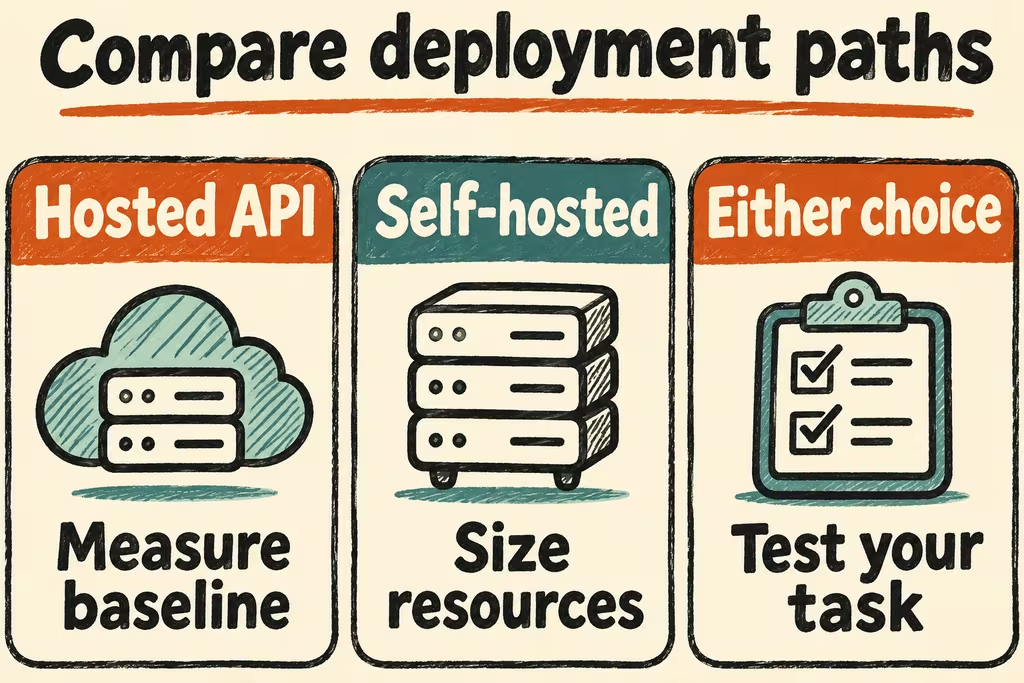
Start with the official DeepSeek Flash API if its data terms work for your task and you want to establish a cost and latency baseline. Try self-hosting only when control over data or sustained throughput justifies the infrastructure, and size the weights, cache, and runtime before reserving hardware.
Which version does DeepSeek Flash serve?
On November 17, 2026 the official pricing page listed DeepSeek-V4.1-Flash-1017 behind the deepseek-flash API name. The retired deepseek-v4-flash and deepseek-v4-flash-vision-exp identifiers accept requests as compatibility aliases for that release. An older name in a client or a third-party service can refer to a different version. Verify the provider's model mapping and record it for every comparison.
The first-party API pricing table separates peak and off-peak usage. It also distinguishes cached and uncached input. Per million tokens, Flash rates checked on November 17 were $0.006 cached input, $0.30 uncached input, and $1.20 output at peak. Off-peak they were $0.003, $0.15, and $0.60. Check the UTC window and holiday exceptions in the provider's table. Tool use can be billed separately.
| Option | Good first use | Verify before widening use |
|---|---|---|
| First-party Flash API | Prototype or low-operations baseline | Returned version, data terms, p95 response time, and cache-adjusted invoice |
| Third-party Flash API | Existing vendor boundary or deployment region | Release ID, tokenizer and feature compatibility, region, and the vendor's own pricing |
| Self-host Flash-1017 | Approved data boundary or sustained, measurable load | Artifact revision, aggregate accelerator memory, concurrent context budget, and recovery drill |
| Smaller local model | Low memory or focused routine task | The smaller candidate reaches the same accuracy floor without extra review |
Estimate the serving budget before self-hosting
The Flash architecture's active parameters describe work per token. Hosting also requires memory for the full resident weight set, runtime workspace, and concurrent key-value cache. Estimate a lower bound from the weight artifacts actually loaded at your selected precision. Run a short and a long prompt at realistic concurrency on a small allocation before making a capacity commitment.
Pin both the revision of the weights and the inference engine. Record quantization, template, and reasoning mode. Recoverability includes restoring those inputs and rerunning your acceptance set.
What two HN discussions add
In a discussion about DeepSeek 4.1 Flash, pianopatrick reported that it was missing from their editor's model list. API availability and the actual model exposed by a tool differ. Verify your real client before treating the advertised endpoint as staff access.
In the independent Flash-1017 release discussion, jononor raised how costly this release was to run locally despite its Flash label. Use the label as a release name. Make the self-hosting decision with measured memory, throughput, and operator cost.
Start with an API baseline and validate the local case
- Pick ten representative approved requests, including one longer prompt and repeated prefixes. Define correctness, p95 response time, peak throughput, and a total budget.
- Measure the exact API model with real cache-hit and miss counters and billed output. Keep peak and off-peak runs separate and log all failed attempts.
- With the same fixture set, test a pinned local artifact and serving stack on an approved small allocation. Measure memory at the actual concurrency, cold start, successful responses per minute, and time to restart.
- Adopt local serving only when quality and recovery meet the agreed floors and the total cost fits your required data boundary and throughput. Stop when required memory, acceptance quality, or restart time exceeds the agreed limit.