 Knowledge Library
Decision in brief
Use local stdio for one trusted desktop client and a small approved integration. Use private Streamable HTTP when several authenticated users need the same service and their client supports the deployment. Begin with a read-only fixture tool and expand only after visibility, revocation and operational ownership pass.
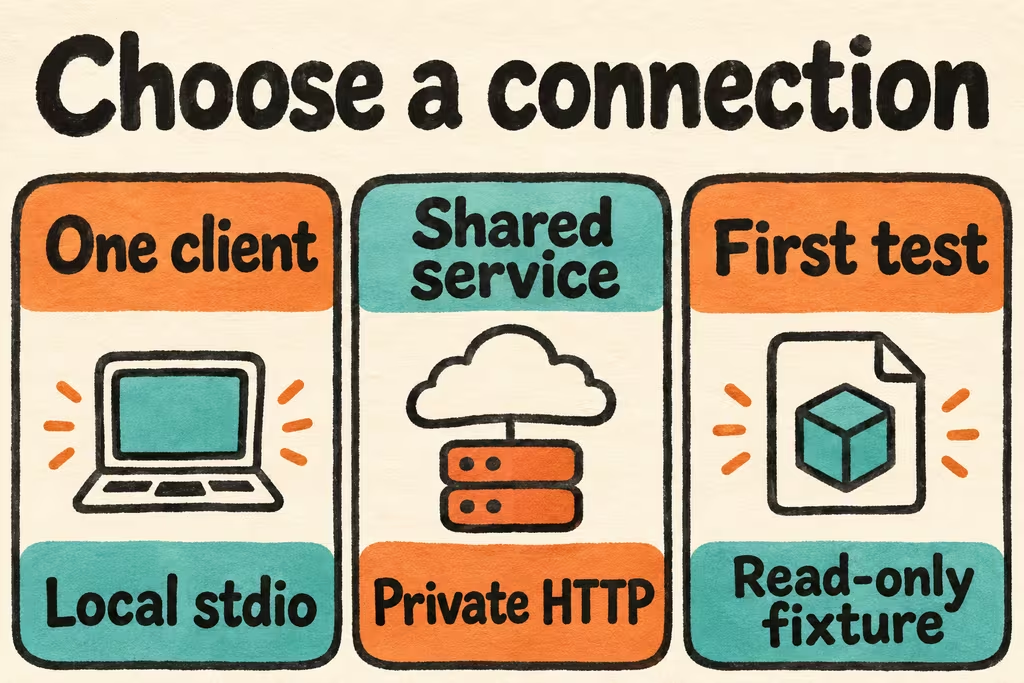
Pick the smallest transport and tool surface
The Model Context Protocol specifies stdio for a locally launched process and Streamable HTTP for a standalone endpoint. Review the server executable and run it under a restricted account. For HTTP, use approved clients, TLS and the specification's authorization guidance. Validate the intended resource audience and keep credentials for downstream APIs separate from incoming client tokens.
Host the pilot only on an approved private path. Expose explicitly selected functions over test data, give the service read-only credentials, and keep shell access, arbitrary database queries and production mutation out of the trial. Record tool name, result category, identity and timing without storing fixture contents or tokens in routine logs.
| Scenario | Start with | Acceptance evidence |
|---|---|---|
| One developer, one approved desktop client | Local stdio and a fixed fixture directory | The approved client can read the named fixture within the granted scope. |
| Small team sharing a test catalog | Private Streamable HTTP with per-user identity | Authorized identities succeed, and a revoked identity is rejected. |
| Integration touches sensitive systems | A synthetic mirror or no connection until scopes can be reviewed | The feature works without production secrets or broad permissions. |
| Several tools need coordination | Independent read-only trials before deciding on a gateway | An operator can identify tool ownership, inspect relevant metadata and revoke access. |
Two HN cases about integration scope
ai_engineering described publishing separate MCP servers for several homelab products. That breadth is a reason to approve tools individually. Keep the first test tied to one bounded data source and one user task.
gadr90 described MCP Mesh as a response to client-by-server configuration growth and difficulty auditing and revoking credentials. Treat simpler setup and enforceable identity boundaries as independent acceptance criteria when assessing shared infrastructure.
Pilot one narrow read-only tool
- Choose one harmless operation such as returning the status of a synthetic ticket by ID. Document the allowed fields, approved clients, authorized identities and expected error behavior.
- Run ten representative read requests against the fixture dataset. Include missing records and malformed inputs. For HTTP, verify the approved test user can reach the server and the configured unapproved identity is denied.
- Revoke the test credential and verify the server honors revocation according to the agreed session policy. Restore the service configuration without copying any live tokens and recheck authorized use.
- Proceed if all ten fixtures return the expected results, revoked access stops within the documented window, and routine logs contain neither credentials nor ticket contents. Stop if the action can read another user's records or the integration requires broader rights than the approved design.