 Knowledge Library
Decision in brief
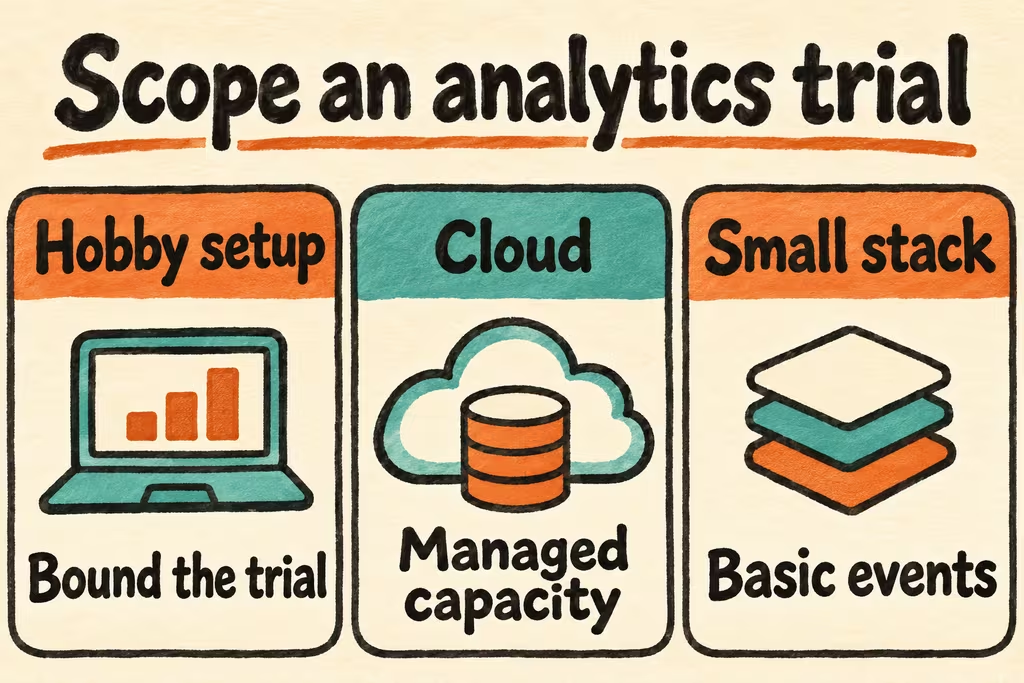
Use the documented PostHog hobby deployment for a bounded analytics trial with time to operate and restore it. Choose PostHog Cloud when production support, cloud-only features, or capacity without an on-call owner matter. Compare a smaller analytics stack if the workload needs only a few pageview and conversion events.
Understand what the self-hosted deployment includes
PostHog documents a free Docker Compose hobby deployment. The vendor does not offer a support plan for self-hosted instances and no longer supports new deployments of its paid open-source product on Kubernetes. A legacy Helm install should have an upgrade or migration plan. The documented beta installer is optional and experimental. Verify current instructions before provisioning.
The hobby guide specifies an Ubuntu VM equivalent to 4 vCPU, 16 GB RAM and more than 30 GB storage. It uses roughly 300,000 monthly events, 1,000 recordings, or 300,000 flag API calls as questions in a decision flowchart. These are screening levels published by the vendor, not capacity guarantees. Peak ingestion, retention, dashboard query cost and disk headroom matter independently.
Use the current Cloud pricing calculator with the actual event, replay, and flag volumes expected for your project. Compare that with the VM, storage, backups, maintenance hours, and tested recovery risk. Cloud usage tiers do not size a self-hosted machine.
| Need | Candidate | Check before sending live data |
|---|---|---|
| Funnel, replay, and flags on an operator-owned test service | Self-hosted hobby deployment | Measure ingestion lag and disk growth using expected bursts and a known recovery point. |
| Production reliance on a tracked feature or strong recovery commitment | PostHog Cloud with the intended plan and region | Verify required features, support terms, event pricing, and data settings for that project. |
| Basic pageviews and a few goals | Smaller event or web analytics service | Run the same questions on the synthetic event set and compare total cost and export effort. |
Use HN reports to plan an upgrade and a privacy review
In a thread about PostHog's open-source repositories, madjam002 reported inconsistent experiences with the hobby install as upstream builds changed. Keep the deployed image references and verify a fresh install or upgrade plus restore before changing the analytics collection endpoint.
In the discussion of PostHog's cloud data policy, sixtyj described different initial defaults across US and EU cloud instances at the time of the announcement. For a current decision, inspect the official policy and the actual organization settings, including region and permitted uses, before sending customer data.
Run a seven-day synthetic analytics trial
- Choose a pilot hostname and the documented hobby deployment. Record the image references, data stores, required settings, and the backup steps for each component. Keep public replay and all production SDKs outside the test.
- Feed a controlled set of synthetic events with known unique users and conversions. Include a burst at expected peak and one dashboard, one recording and one flag evaluation if needed. Check event totals against the fixture and record peak CPU, RAM, disk growth and time to visible data.
- Restore onto an isolated replacement host from the backup set you recorded. Check the known event counts and project settings. Test the next candidate build separately, with the same checks.
- For example, require reconciled event counts, 95% of synthetic events visible within two minutes during peak, and recovery within four hours from the last backup. Adjust to actual needs. Keep live collection on the existing service if any required feature, capacity, privacy, or recovery test fails.