 Knowledge Library
Decision in brief
Use standard GitHub-hosted runners for public work and ordinary private jobs that fit the offered machines. Pilot self-hosting for trusted private work that needs a private dependency, dedicated hardware or a proven cost or performance gain. Prefer a clean single-job worker for scale-out and limit its group to selected repositories and workflows.
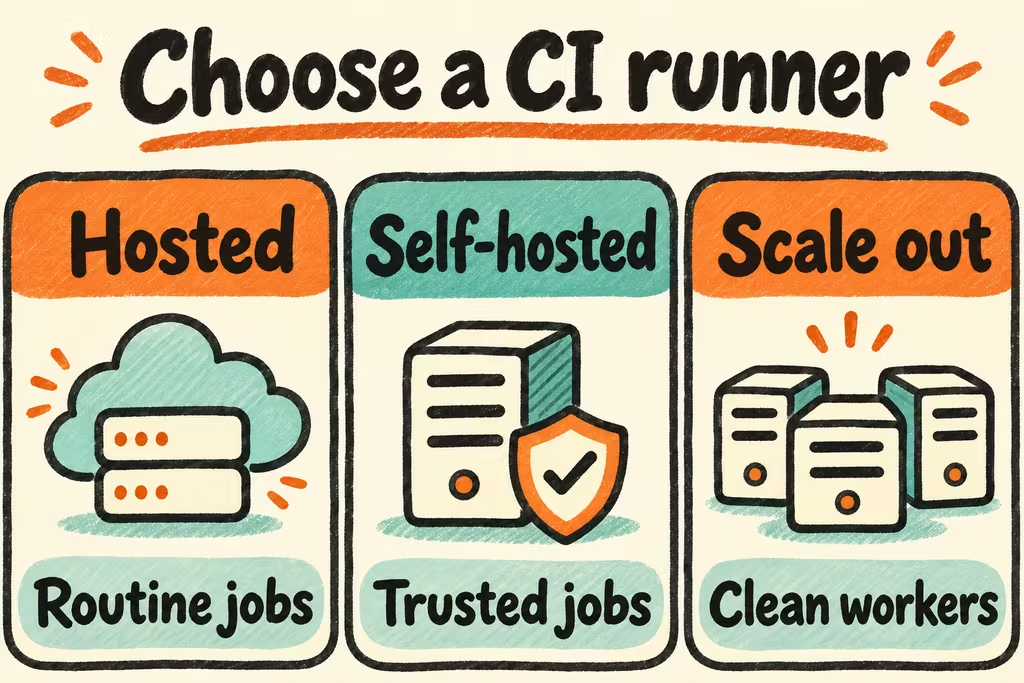
Hosted versus self-hosted GitHub Actions runners
Test the requirement hosted execution fails to meet before operating a fleet. For machine size or image differences, compare suitable hosted SKUs. For trusted jobs that need a private staging dependency or specialized hardware, restrict access to the specific job and use separate groups and images for different privilege levels. Treat trust as a property of the workflow and its contributors, including on private repositories.
GitHub recommends ephemeral runners for autoscaling and provides Actions Runner Controller for Kubernetes scale sets. An ephemeral registration accepts one job. Plan to discard the compute and workspace after use and keep accessible logs after shutdown. Allow for image updates, queue management and support.
| Execution model | Best starting point | Decision check |
|---|---|---|
| GitHub-hosted standard | Public contributions, common OS images and bursty builds | Confirm supported tools, private connectivity requirements and compute account |
| GitHub-hosted larger | Jobs bottlenecked by resources on standard images | Measure completed-job cost and elapsed time for the larger SKU |
| Persistent self-hosted | One narrow, approved workflow with dedicated hardware | Name an owner and test job access, state retention and recovery |
| Ephemeral self-hosted | Trusted jobs that need clean workers, private access or capacity that scales | Prove worker disposal and inspect off-worker logs after a failed or canceled job |
A GitHub Actions pricing calculator you can reproduce
Export jobs by billing owner and SKU. For each hosted job, round its duration up to a whole minute and apply the matching rate before summing. GitHub’s current rate card lists standard Linux 2-core x64 at $0.006 per minute and Windows 2-core x64 at $0.010 per minute. For 500 Linux jobs of 7.2 minutes and 120 Windows jobs of 5.1 minutes, the gross total is 4,000 × $0.006 plus 720 × $0.010, or $31.20.
For eligible private or internal jobs, included compute usage offsets the gross total based on the repository owner’s account. Other eligible compute products can share that allowance. Standard hosted minutes for public repositories and self-hosted compute are free through GitHub Actions. Larger hosted runners are billed on public repositories. Price artifacts and cache storage separately because GitHub tracks storage usage over time under separate allowances.
For self-hosted workers, model compute, idle capacity, storage, network, monitoring and engineering time. If a test fleet costs $25 for infrastructure plus a quarter hour of operations at an illustrative $48 per hour, the comparable subtotal is $37 before other charges. Use your actual successful job mix, included usage and retention to decide. The $25 and $48 values are example inputs, while the hosted per-minute values come from GitHub’s published table.
What Hacker News projects tried
vrajat described building a runner setup to use owned hardware for simple workflows. This was a project goal. Verify capacity and division of responsibility before assuming those workflows will stay inexpensive.
In a separate discussion, fodoj prototyped MicroVM-based runners and described adopting them for some work. Use the project as a prompt to measure provisioning, idle headroom and teardown. Read current official pricing for the workloads you evaluate.
Run a private-repository setup trial
- Use a private sandbox with synthetic inputs and a hosted baseline. Restrict the trial runner group to its approved jobs and use a dedicated test identity with minimal permissions.
- Run the same workload mix on both paths. Record queue-to-start time, execution time, successful jobs and billing or maintenance inputs. Keep comparable cache and artifact policies.
- Use a harmless workspace marker to verify cleanup between ephemeral jobs. Cancel a separate test job and check secure teardown, external logs and the approved staging dependency path.
- Move a single trusted workflow if queue, cost, isolation and recovery pass your declared thresholds. Stop if a worker retains unintended state or can reach an unapproved repository, dependency or credential.