 Knowledge Library
Decision in brief
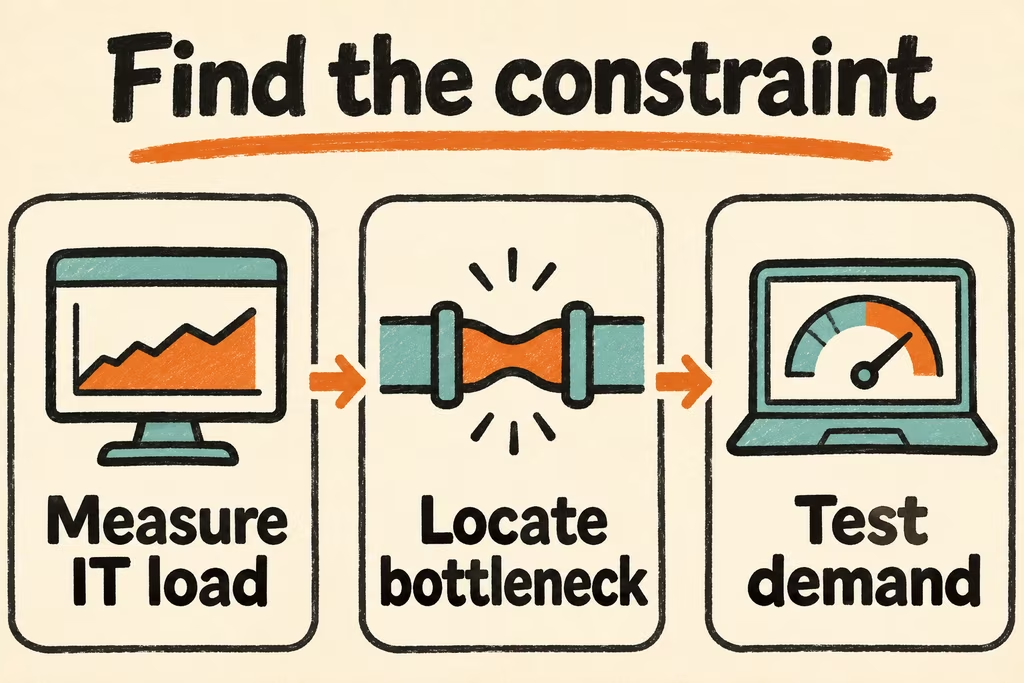
Keep a separate ledger for cash spent, utility service available, commissioned IT capacity, metered power, and useful work completed. Locate the facility constraint before proposing new capacity. If power and cooling are available but queues result from job placement, workload fit, or software, address those bottlenecks first. Advance facility expansion when a measured constraint persists through a representative demand period.
Define a different denominator for each utilization metric
Inventory requested service, contracted service, power that can actually be energized, and commissioned IT capacity by hall. Facility MW includes non-IT load such as cooling and power overhead. Commissioned IT MW is the installed load capacity accepted for operation at the IT electrical boundary. Record the redundancy reserve, rack power limits, and commissioning date so a theoretical nameplate rating cannot be counted both as operating capacity and future capacity.
For example, a hypothetical campus has 60 MW of contracted utility service, 30 MW of commissioned IT capacity, and interval-average draw of 24 MW at the facility and 18 MW at the IT boundary. The latter is a 60% draw against commissioned IT capacity. Matching the meters across the same interval gives a facility-to-IT energy ratio of 1.33 for that interval. Neither ratio can tell you how busy GPUs are or how much useful work they do. Capture queue delay, GPU hours allocated and actually busy, throughput, and service-level violations by workload.
| Record | Use | Check before comparing |
|---|---|---|
| Committed and paid spend | Track budget and time to service | Distinguish capital costs, operating expenses, and contracted spend |
| Available facility power and commissioned IT MW | Check what can take load under the current operating plan | Verify ramp schedule, location, and reserve policy |
| Facility and IT meter readings | Measure draw, peaks, and overhead | Use matching time periods and electrical boundaries |
| Scheduler and application counters | Find what is delaying useful work | Report allocated hours, active time, queueing, and output quality separately |
What to check when a headline extrapolates from spend
ic_fly2 posted a back-of-the-envelope token output estimate in a thread about AI data center spending. The inputs included an energy-per-token claim, a plant rating, and assumed utilization. Recalculate from your own workload mix and metering interval before using a throughput estimate for an operating decision.
In a separate construction-capacity thread, CodingJeebus asked whether the projects under construction were even on schedule. Convert each project milestone into an owner-dated readiness record for energization, commissioning, and workload acceptance.
Run a four-week capacity and demand reconciliation
- Choose an authorized hall and one workload class. Mark the utility, UPS, rack and application reporting boundaries. Ask facilities for commissioned and usable IT limits, contingency reserves, and delivery milestones.
- Align approved facility telemetry with scheduler and service counters over four weeks, extending the window if it misses the expected demand peak. Record peak and typical IT draw, allocated and busy time, queue delay, and successful work delivered. Document missing intervals and maintenance.
- Replay the demand trace in a planning model with a scheduling change and a proposed expansion as separate options. Compare delivery time, capacity spare during the design contingency, and whether the added assets would address the observed constraint.
- Accept an expansion phase only if matched data show sustained service-level misses caused by a facility limit and the proposed phase has a verified power and commissioning path. Stop if the meters do not reconcile, the apparent limit is confined to one placement constraint, or the next power handoff has no confirmed date.