 Knowledge Library
Decision in brief
Select one technology, region, and period when interpreting a clean energy investment trend. Track spending alongside commissioned MW and delivered MWh, with emissions or water separately measured against a baseline. For a solar-over-canal proposal, test the extra civil works, operator access, and water benefit against both nearby ground-mounted PV and a comparison section of uncovered canal.
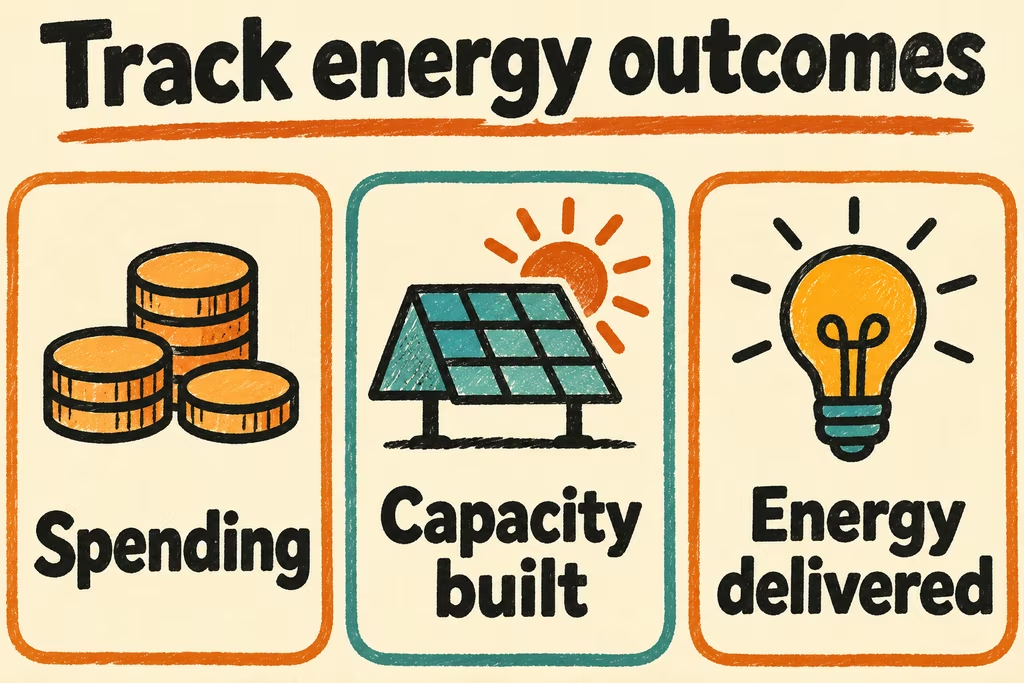
Keep the investment and operating records separate
IEA's World Energy Investment tracks capital flows with a defined accounting methodology. For example, some generation investment is apportioned across the project timeline. Keep an announcement, authorized funding, spending incurred, and commissioning in separate fields. Label estimates and forecasts. For changes over time, retain how the currency, price year, geography, and technology coverage were defined.
Use a separate series for generators and their actual output. In the U.S., EIA reports generator status and capacity through the 860 collection and plant operations through 923. Deployment can lag capital spending. Local generation can change with weather, outages, and curtailment. A climate claim also needs a transparent estimate of what would have happened without the project.
| Question | Evidence to collect | Keep separate |
|---|---|---|
| Did investment rise? | Comparable capital-spending series with price year and currency | Announcements, financing commitments, and incurred spending |
| Did the assets arrive? | Dated generator status and commissioned MW | Proposed capacity, construction, and operation |
| Was more clean electricity delivered? | Metered MWh by region and period | Peak capacity, curtailment, and expected annual yield |
| Do canal panels improve outcomes? | Delivered energy, recorded access and maintenance, and estimated avoided evaporation | Water and electricity results, with separate baselines |
Assess solar panels over irrigation canals as a site-specific pilot
California announced completion of the Project Nexus pilot in April 2026. The university partner describes the Turlock Irrigation District project as a place to test water and power outcomes. Compare candidate spans on widths, support requirements, and interconnection. Ask the canal operator how crews remove trash, control vegetation, inspect banks, and reach gates. Confirm lift clearance, scheduled shutdowns, and emergency access before pricing the structure.
In the HN thread about the California pilot, nbf_1995 proposed ground-mounted solar and separate canal shade as a comparison. Price that third design when evaporation is the main goal. In a separate thread, jfengel noted that a solar-nuclear headline compared one period's generated electricity. The time interval and metric belong beside any milestone claim.
Screen one site and define the stop criteria
- In a desk review with the canal owner, shortlist one span and one plausible local ground site. Obtain survey dimensions, climate records, the maintenance calendar, rights of way, and available connection capacity.
- Request comparable estimates for structural work, generation equipment, replacement, interconnection, and lifetime access costs. Estimate annual net MWh from local irradiance and shading. Define a matched uncovered stretch or an agreed water-balance method with the operator.
- For an authorized pilot, compare seasonal output and evaporation estimates against the controls using the same weather and operating periods. Log equipment outages and time required for legitimate maintenance. Show measurement uncertainty beside the estimates.
- Advance only if the operator signs off on routine and emergency access, the comparison is reliable enough to test the agreed water benefit, and local cost and generation targets hold. Stop or redesign if the span obstructs maintenance, or if the measured water effect cannot be distinguished from seasonal variation.