 Knowledge Library
Decision in brief
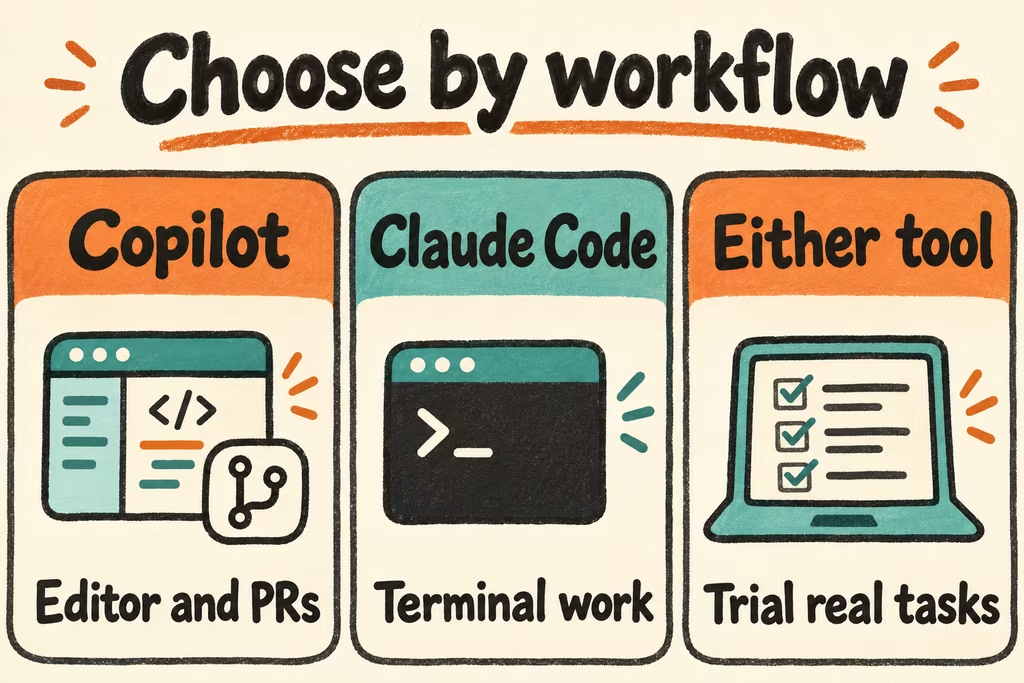
Start with GitHub Copilot when the main problem is fitting assistance into an existing editor and GitHub PR workflow. Start with Claude Code when maintainers prefer to drive repo work from a terminal or need an explicit GitHub Actions workflow. Test editor usage and issue-to-PR usage separately: a Claude model offered through Copilot runs through a different product workflow from Claude Code.
What will the tool do, and with whose permissions?
GitHub documents Copilot surfaces for editors and GitHub itself, including an asynchronous repository agent. Claude Code can work in a local checkout; its GitHub Action can respond to @claude mentions or configured events when an authorized maintainer installs it and grants the required permissions. A terminal session and an issue-triggered repository job have different access and reproducibility requirements.
If you compare pricing, use GitHub and Anthropic’s plan documents and check your account entitlement, model/provider, CI charges, and approvals. A smaller per-seat budget can lose to slower review and correction; compare cost per accepted change rather than treating requests, tokens, and seat prices as interchangeable.
| Team workflow | What to test first | Evidence you need |
|---|---|---|
| Python in an existing IDE | Compare Copilot in the team IDE with Claude Code using the same venv and fixtures. | Correct interpreter, targeted tests pass, typing and docs remain consistent, and little cleanup is required. |
| GitHub issue assigned to an assistant | Try GitHub’s Copilot agent with a small approved repository and scoped acceptance tests. | Traceable issue-to-PR handoff, CI runs under the right policy, and a teammate can reproduce it locally. |
| Team owns the workflow and its triggers | Pilot the Claude Code GitHub Action in a disposable repository with a maintainer-approved trigger and permissions. | Review the actor, PR branch policy, failure logs and ongoing ownership before expanding access. |
| One license per developer | Use both in a time-boxed trial, then buy for the prevalent workflow. | Compare accepted changes per developer week, PR review time and total actual spend under your plans. |
HN examples point in both directions
zabil said they moved from Claude Code to Copilot because PR management fit their GitHub repositories, and management was reluctant to fund both enterprise licenses. In a separate discussion, hhimanshu reported a better experience assigning issues through Claude Code’s GitHub integration than through Copilot. These were personal experiences with particular setups, not a controlled benchmark or a current entitlement check.
The difference is actionable: one person valued the PR management surface, while the other cared about what happened when the assistant owned an issue. Score both parts of a real task instead of collapsing them into an overall model preference.
Run an end-to-end Python trial in a disposable repository
Use an issue with independent fixtures: the CSV importer should reject a file missing a required header, preserve UTF-8 text and still accept the previous valid samples. Keep the tests and dependencies identical across both tools.
- Run python -m pytest from the agreed virtual environment, record the baseline, and define the expected files and behavior. Trial both clients from a clean branch using the same requirements.
- Run the editor or terminal lane first. Record the model, where the tool ran, the interpreter it used, how long it took to get to green, and whether it touched any unrelated files.
- If GitHub handoff is required, run a separate lane in the approved sandbox repo using each product’s authorized integration, the same CI, and no auto-merge. Have a teammate follow each PR back to the issue and rerun the tests.
- Pick the tougher of your real gates: an accepted local diff, or a reviewable PR with green CI. Compare human minutes to that gate and reject a workflow that cannot meet the team’s branch and repository access rules.