 Knowledge Library
Decision in brief
Use Docker containers for apps that can share the host kernel and benefit from a repeatable image and fast replacement. Use a virtual machine when you need a separately managed guest kernel or an OS environment the application expects. Use Docker inside a VM when you want that guest boundary and the same container artifact from build through deployment.
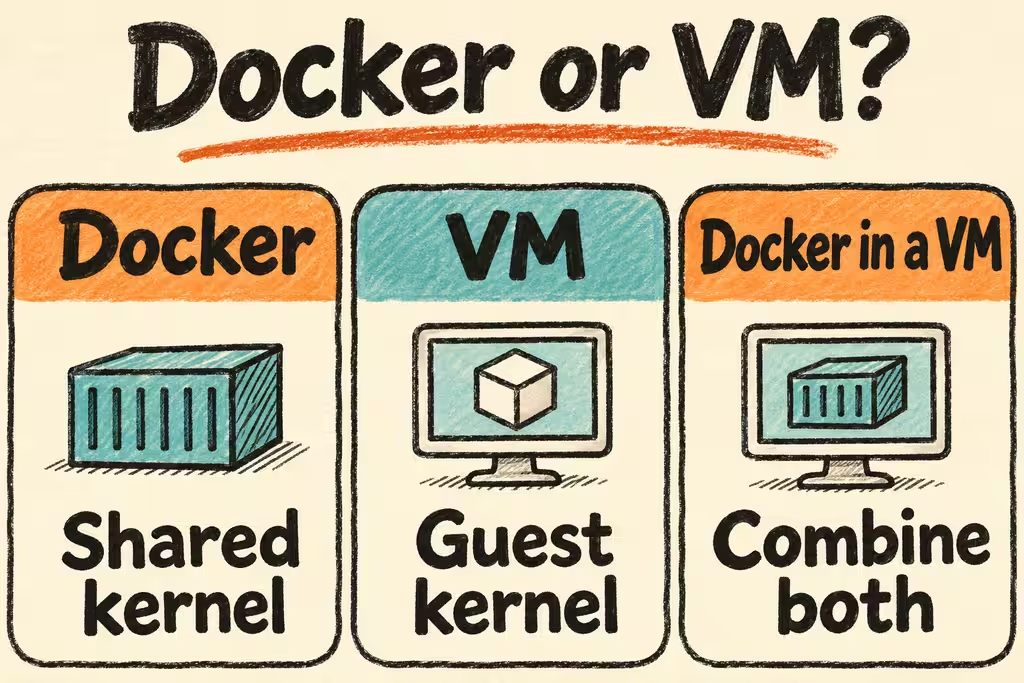
Docker vs VM: shared kernel, guest OS, and management boundaries
On a native Linux Docker Engine, Linux containers run as isolated processes that share the host Linux kernel. A VM boots a guest kernel on a hypervisor. Docker Desktop uses a Linux VM to run Linux containers. When you measure a desktop workload, account for the VM itself as well as the containers inside it.
The VMware comparison is typically Docker application packaging versus a VMware virtualization environment. They can operate in the same deployment. The equivalent question for a service is how much of the environment needs to move together and who patches it. A VM introduces another OS to maintain. Resource limits for Linux containers can constrain workloads when configured for the host and application.
| Requirement | Docker container | Virtual machine |
|---|---|---|
| Ship an app from CI to several environments | Build one image per required platform and supply runtime settings. | Distribute a guest image or install an approved app artifact inside the guest. |
| Run a workload with its own kernel and system packages | Linux containers on the same engine share its Linux kernel. | Choose the supported guest OS and manage its lifecycle. |
| Separate workload and infrastructure responsibilities | App configuration and state need an owner. Host OS is shared. | Assign ownership for guest OS, network access, and image or backup lifecycle. |
| Recover after host loss | Recreate runtime configuration and restore state on a replacement host. | Boot a verified guest recovery image and check the attached or separately restored state. |
How HN operators combine containers and VMs
In a Proxmox discussion, tracker1 described hosting Docker web apps in an Ubuntu VM and giving certain workloads dedicated VMs for separation and network needs. This is a way to keep container packaging while assigning separate guest boundaries where a workload calls for them.
In a discussion about Docker on Mac, avsm described Docker for Mac beta and the LinuxKit groundwork. That history is relevant when laptop and production timings disagree. Record whether your local test includes an always-on Linux VM, filesystem sharing, or a different processor architecture before comparing numbers.
Compare Docker and VMs using one service in staging
Decide which workload needs its own kernel and what recovery time and data loss the service can accept. If a guest kernel is a requirement, compare a VM with native app deployment to Docker inside that VM. Otherwise, include native Docker on Linux in the trial.
- Deploy the same app release with the same processor architecture, resource budget and fixture data. Document whether dependencies run on the same host or externally and use the same dependency placement for both measurements.
- Measure idle memory, startup until a successful external readiness check, and peak request latency under the same input. Record whether cold starts include downloading an image or booting a guest.
- Stop the app, then rehearse loss of its staging host. Record time to the first correct request and newest recovered record. Verify where the OS, artifact, database backup and runtime configuration are versioned and restored.
- Choose the arrangement that meets OS and recovery requirements with a runbook the assigned operator can complete. Include guest image and container maintenance in the cost of a mixed deployment.