 Knowledge Library
Decision in brief
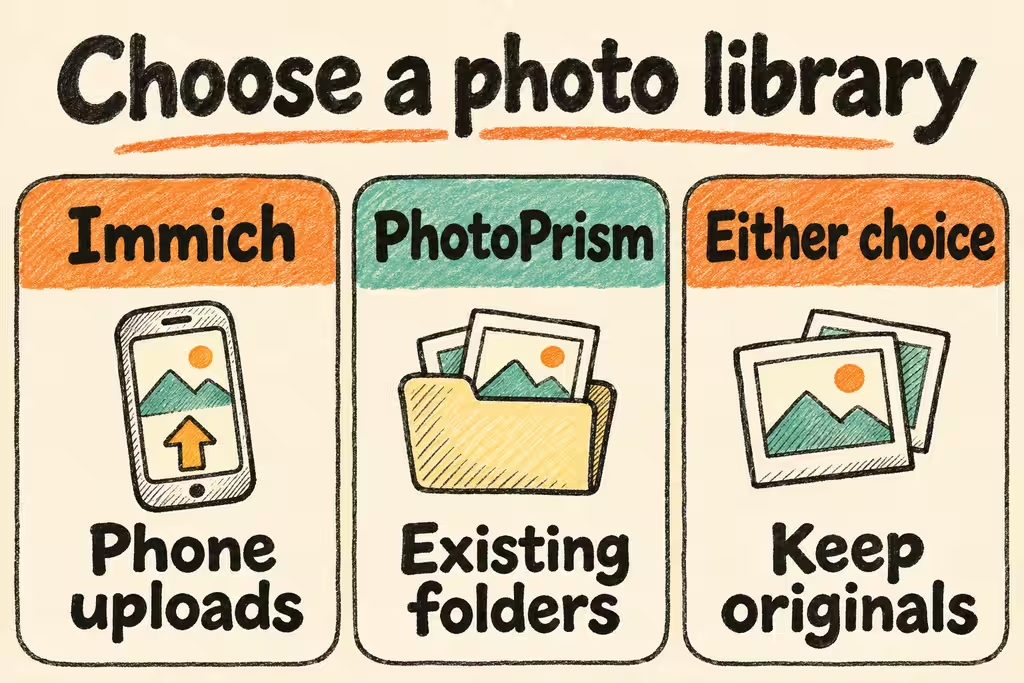
Start with Immich when automatic phone uploads and a shared household gallery are priorities. Evaluate PhotoPrism when an existing folder tree is your source of truth and you primarily want to browse and index it. Keep an independent copy of the original files and test recovery of the catalog before replacing a working photo service.
Decide where the originals and edits live
Immich can upload photos and videos from selected mobile albums and can mirror album membership from the phone to the server. The mobile operating system controls background scheduling, so a successful foreground upload is only one test. Immich can also index mounted external libraries while the base files stay in their existing directories.
PhotoPrism indexes photos and videos from an originals folder. Compare the workflow for ingesting new files against how you already copy files from phones and cameras. A database copy alone cannot recover missing originals. Keep application metadata and original media in a coordinated backup, then restore the expected albums or labels on a separate instance.
| What you need | Start here | Check in staging |
|---|---|---|
| Automatic camera roll uploads | Immich with a selected test album | Observe foreground and background arrival after a missed network window. |
| A curated NAS folder is authoritative | PhotoPrism originals or Immich external library | Check read-only mounting, rescans, and whether edits travel with the original files. |
| Household sharing | A gallery with separate pilot accounts | Verify owner and recipient views, permissions, and access after revoking a share. |
| Loss of the application server | Independent media backup plus catalog restore | Verify original files, capture dates, albums, and recoverable video playback. |
What two HN users exposed about phone access and archival ownership
In a discussion of a self-hosted Immich setup, cuu508 reported using separate local and remote connection names on an ARM device. The pattern suggests testing home Wi-Fi and away-from-home access independently. Their device and network are one configuration, so measure upload completion on your own.
In the Noodle Gallery discussion, jmathai described treating Google Photos as a viewer of a separate canonical library. That is a useful model if you want the originals to outlive the chosen gallery. Rehearse opening the originals and rebuilding a small catalog without the current server.
Pilot one album and restore it on a clean host
Keep the current upload path enabled and work on copies of the originals.
- Pick 60 representative photos and videos, spanning phone and camera sources. Record the names, capture dates, sizes and checksums of the copied originals. Include a duplicate and an album shared with a second account.
- Import the legacy sample and take five new photos on the phone. Observe uploads after Wi-Fi reconnects with the screen locked, and test gallery access on the devices your household actually uses.
- Restore media and application state onto a clean private instance. Match original-file checksums, review capture dates, open the longest video, and confirm the expected album membership and share access.
- Switch only when every original matches, the test album completes upload within your agreed window, and a recovery operator can restore within the time you can tolerate. Pause if a file is only present in a thumbnail cache or if private albums become visible to the wrong account.