 Knowledge Library
Decision in brief
Pilot Stoat for a Discord-style community with channels and roles. Pilot Matrix with Element if federation, portable standards, or access across different communities is a requirement. Try Mumble when reliable low-latency voice is the main job and your group already has a place for text. Keep both services available in a short volunteer pilot and compare voice, push notifications, role permissions and member onboarding before moving the full community.
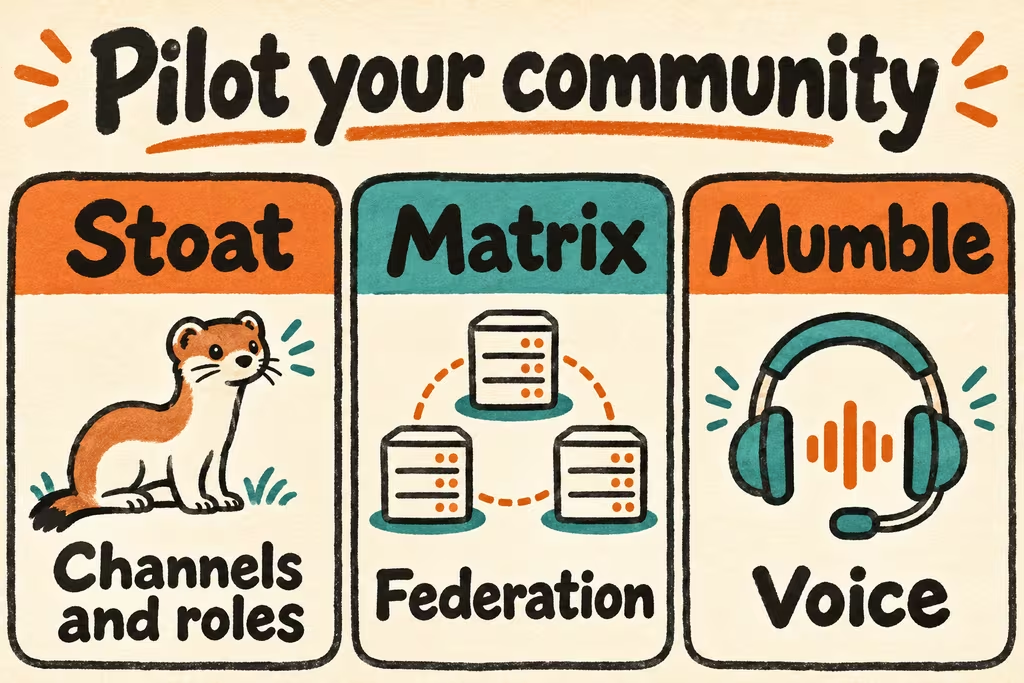
Which self-hosted Discord alternative fits your group?
Start with the activities that happen every week. A gaming group may require dependable voice and quick reconnects. A technical community may need searchable support threads, structured onboarding, bot moderation and room permissions. A community spanning multiple organizations may need server-to-server federation. Treat cross-device notifications, screen sharing and existing bots as test cases on the intended versions.
Stoat provides its own self-hosting instructions and lists client connection guidance. Matrix is a protocol with server and client choices. If using Element for Matrix group calls, include its calling components in the deployment and test the full media route across real networks. Mumble focuses on low-latency voice, so plan where persistent text, links and support history will live.
| Option | Likely fit | Blocking trial question |
|---|---|---|
| Stoat | A community that wants a familiar channel and role layout | Can each member's actual client reach your instance and use the voice and notification flows you require? |
| Matrix with Element | A community that requires federation or Matrix clients | Can members join and recover access on a new device, and do calls and moderation work on your selected stack? |
| Mumble | A gaming or hobby group where voice is the main blocker | Can guests join quickly and stay connected, and is the separate text workflow acceptable? |
What HN users learned about running chat
In a self-hosted Matrix discussion, pelzatessa described operating Synapse with a database and reverse proxy, then adding calling and authentication components for Element clients. Ask who will support each component and rehearse restoring the core chat service before relying on it.
In a separate Discord-alternative discussion, bob1029 described a group moving away from TeamSpeak because of what members wanted to use together. A host can deploy a service in an afternoon, but participation determines whether it replaces the old one. Measure how many volunteers return for a second event unprompted.
Test migration with a small group
Recruit people who use different devices and networks. Copy an approved channel structure and use test accounts and synthetic history. Agree who manages incidents, roles, spam and upgrades before you invite the full community.
- Create a public channel, restricted channel and moderator role. Invite a guest from mobile and desktop and check which rooms and actions each role can see.
- Run a group call across home broadband and mobile, then repeat after a reconnect. Run screen sharing when it is required and check delivery of notifications while the phone is locked.
- Recreate one critical bot or moderation flow. Document how members can be removed and what historical content can be retained with permission.
- Restart the test deployment and restore it from its backup. Check room membership, attachments and call setup. Proceed after a second pilot event if members join unaided and the named operator can recover the service.