 Knowledge Library
Decision in brief
Start with the work customers or sponsors will actually pay for. Try support if buyers mainly need accountable expertise. Try hosting if reliable operations create the clearest value. Consider open core if you can maintain a useful open-source edition alongside separately licensed capabilities. Use sponsorship or public funding where shared infrastructure benefits many users who need little bespoke work.
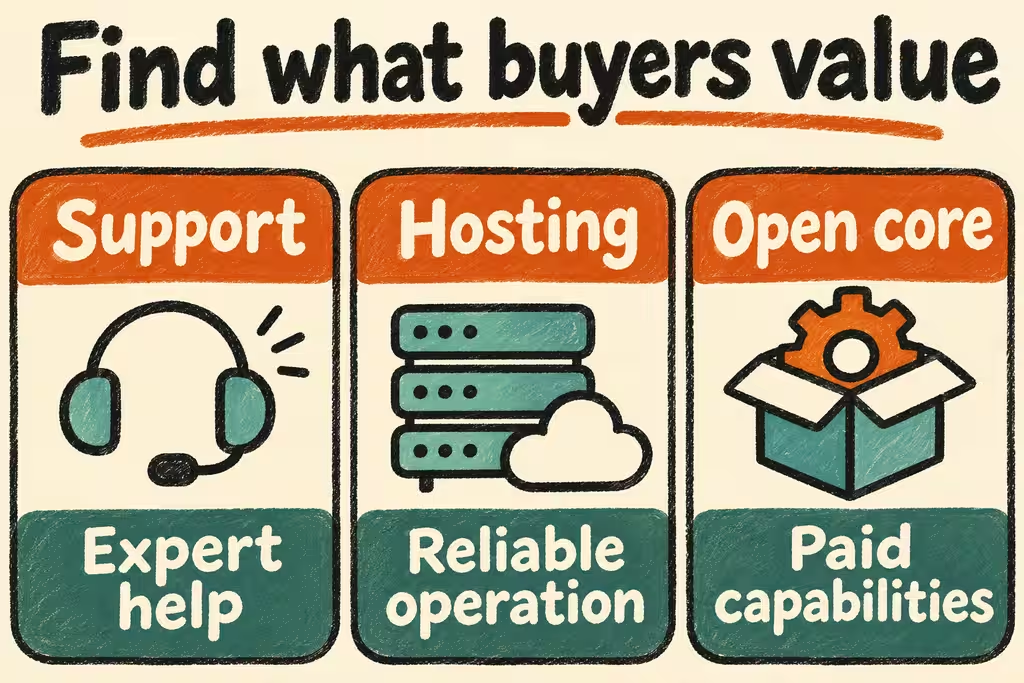
Compare open source business models and their obligations
A revenue model defines who pays and what they receive. The license defines what recipients can do with the covered code. The Open Source Initiative lists free redistribution and freedom from field-of-use restrictions among its criteria. Audit the actual license for the release and document the boundaries of paid services, separately licensed code, and trademarks. Where an important clause is unclear, resolve it with the responsible maintainer and qualified counsel before changing terms.
GitLab describes its open-core stewardship commitments in its handbook. GitHub Sponsors illustrates ongoing contribution funding. The Sovereign Tech Fund offers a different route aimed at public digital infrastructure. Each answers a different need. Identify who funds maintenance when a hosted customer leaves or a grant ends, and which services would remain available to the existing community.
| Who pays for what | Revenue model | Key risk to rehearse |
|---|---|---|
| Organizations pay for upgrades, training, or response | Support and services | Maintainer time can be consumed by one customer's incident schedule |
| Teams pay to avoid running infrastructure | Managed hosting | Hosting cost and incident work can rise faster than collected revenue |
| Teams pay for additional features or enterprise controls | Open core | The free edition becomes hard to operate or the paid-feature boundary is unpredictable |
| Many users rely on shared maintenance | Sponsorship, grants, or public funding | Funding may be concentrated, time-limited, or tied to specific work |
Two HN cases about funding and project boundaries
kvinogradov introduced the Open Source Endowment in a discussion about sustaining critical maintenance. Treat recurring funding as its own experiment. Record the promised duration, purpose, and governance for each pledged contribution and simulate losing the biggest donor.
In a separate discussion, RossBencina distinguished different restrictions that can accompany a source-available license. Read the applicable version and test what an existing adopter can reproduce, share, or run without a commercial account. Track any license questions that need an answer before a release.
Run a small paid-pilot or funding trial
- List the ten largest categories of maintenance work and calculate a monthly labor and infrastructure baseline. Separate emergency response, upstream upkeep, and customer-only requests.
- Ask three likely buyers or sponsors which result they would fund, for how long, and with what expectations. Propose one pilot and write measurable delivery boundaries and renewal terms.
- Inventory release licenses and paid boundaries. Have an independent contributor install, build, and use the documented open edition. Simulate losing one customer or sponsor and price the work that remains.
- Proceed only if the trial has a real funding commitment, satisfies a defined maintenance target, and leaves a clear, usable open edition. Stop if rights are unresolved, paid promises exceed on-call capacity, or losing one sponsor makes the required upkeep infeasible.
Corporate open source sponsorship and upstream contracts
Choose the payment channel according to the work. Use recurring sponsorship for shared maintenance when the maintainers can direct the money according to project needs. Agree a scoped contract for paid support or a named deliverable. Fund staff contribution time when upstream has said it can review and sustain the work. A payment creates value when the recipient has time to act and there is an agreed plan for review and maintenance.
Check who receives the money, controls review and release decisions, and owns new work under the agreement. Put deliverables, rights and applicable licensing, credits, maintenance after handoff, and exit conditions in writing. The Rust Foundation presents its Maintainers Fund as a recurring support mechanism. In the HN discussion, mperham asked who would receive money, how much and on what schedule. In a separate thread, sdoering shared Mautic's appeal for community support after a stated funding shortfall. The two cases suggest documenting payments and evaluating ongoing capacity before promising a patch date.
- Pick one production dependency. Write down who relies on it, how the dependency fails and which maintainer capacity your budget is intended to improve.
- Ask the listed project contact which funding routes it accepts. Identify the money recipient, review authority and people who would own the work when the initial funding ends.
- Run a bounded pilot with a documented payment schedule, agreed outcome and review date. Track whether funds reached the intended recipient and whether maintainers could complete or schedule the agreed work.
- Renew only after payments are traceable and the project can sustain the work under the agreed terms. Pause if rights, maintenance, or who controls release decisions remain unclear.
| Buyer need | Funding route | Evidence to collect |
|---|---|---|
| Sustain release and triage capacity year over year | Recurring sponsorship or a foundation fund | Identify eligible recipients, reporting, continuity, and decision rights |
| Get an agreed patch or response window | A written development or support contract | Confirm scope, acceptance test, license, review path, and support after delivery |
| Send a staff-maintained change upstream | Budget engineering and upstream review time | Confirm a maintainer wants the change and record the long-term owner |