 Knowledge Library
Decision in brief
Form S-1 is a U.S. Securities and Exchange Commission registration statement used for some securities offerings, including many initial public offerings. Start on EDGAR with the issuer’s exact name and filing history. Read the cover and risk factors, then trace a business claim to its definition and the financial statement notes. Compare later filings before describing the terms as final.
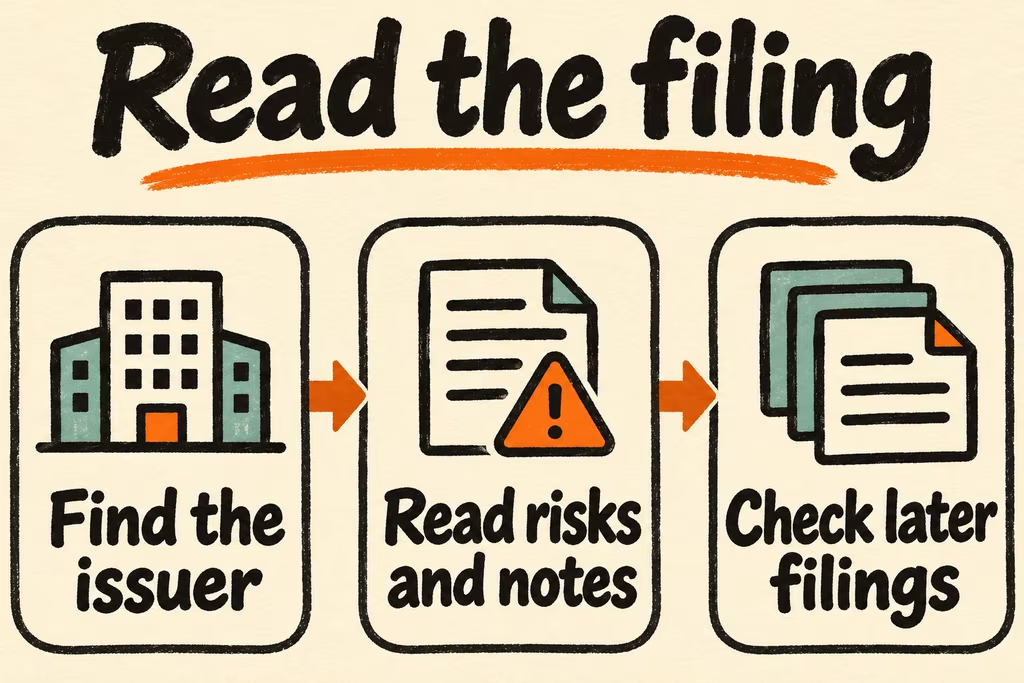
Read the filing in the order that answers your question
The SEC describes two main parts of a registration statement. Part I includes the prospectus. Part II records additional disclosures and exhibits. For a proposed offering, the cover can leave items such as the price and share count blank. EDGAR may later show an S-1/A amendment and a separate final prospectus, commonly filed as 424B4 for a priced IPO. Confirm the document type and date before quoting it.
Use the issuer’s EDGAR filing sequence to keep versions straight. Make a distinction between proceeds to the issuer and shares sold by existing holders. Check the class and voting rights of the offered securities. If the filing uses a management-defined metric, take its definition and period from the filing and compare it separately with the audited financial statements.
| Question | Start in the filing | Write down |
|---|---|---|
| What securities are offered? | Cover and description of capital stock | Share class, voting rights, and whether quantity or price is preliminary |
| Where is the money going? | Use of proceeds and selling security holders | Recipient, expected use, and any stated assumptions |
| What could materially change results? | Risk factors and notes on commitments | One specific dependency and the exposure described by the issuer |
| Do the figures support the headline? | Financial statements, notes, and any metric definition | Reporting window, units, accounting basis, and whether a later filing changed it |
Two HN examples for a filing reading exercise
In the Anthropic S-1 discussion, simoncion distinguished reported losses from their reading of fair-value effects. Use that disagreement to locate the accounting line item and verify how the published period and basis relate to the published total. Treat any adjusted figure as a separate calculation.
firexcy shared Oura’s S-1 in a different HN thread. Its filing gives a second issuer for the same exercise. Find the issuer’s own metric definitions and check whether a line with a similar label has the same scope and reporting window before comparing it with Anthropic.
Validate one claim against an S-1 and its amendments
- In EDGAR, record the issuer name, filing date, form type, and accession number. Open the main filing and locate any later amendment or final prospectus.
- Extract the security class, one offering term, one stated risk, and one financial figure. Record the section link, date, period, units, and definition for each.
- Check one source claim independently against the financial statements or applicable exhibit. If a new filing exists, compare that same item across versions and note what changed.
- Keep a claim only if another reader can reproduce it from the linked filing and period. Stop and mark it preliminary or unresolved if pricing is blank, definitions differ, or you cannot reconcile the version.