 Knowledge Library
Decision in brief
Shortlist Valkey when existing Redis OSS commands and clients matter most. Test Dragonfly when memory or throughput is the reason to switch, and Memcached when the workload is only disposable key/value caching and the application can change clients. If Redis carries durable messages, locks or application records, evaluate those guarantees explicitly before selecting a replacement.
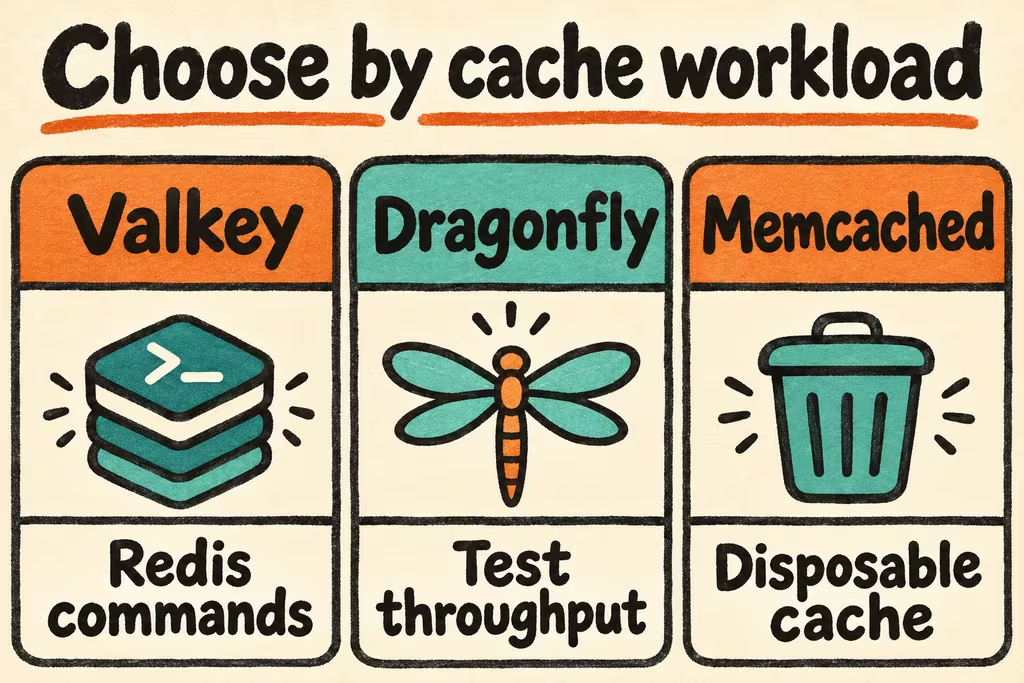
Match the alternative to the role Redis plays
List endpoints by role before comparing products. The same deployment may serve recomputable pages, sessions, streams and locks. Put a value on losing each keyspace and separate them when they need different durability or eviction policies.
| Role | What to shortlist | What can rule it out |
|---|---|---|
| Existing Redis API, scripts or client integrations | Valkey; keep Redis as the baseline | Check every required command and script plus modules, ACLs, cluster routing and persistence file compatibility for the actual source and target versions. |
| Large hot cache with memory or CPU pressure | Dragonfly, Valkey, and the current Redis configuration | Replay realistic value sizes, request bursts and pipelines. Confirm p99 and memory at the same hit rate and review the supported command list. |
| Disposable simple cache with an authoritative backend | Memcached or an in-process cache when instances may hold their own copies | Measure backend load during cache loss. If the app relies on Redis data structures or scripting, budget application changes. |
| Streams, scheduled jobs or messages that cannot disappear | A Redis-compatible option only after consumer-group behavior passes, or a queue designed for your delivery contract | Measure pending message recovery and duplicates across restart and failover; set retention and replay requirements up front. |
| Locks, counters or records that must stay correct across failover | Keep authoritative state in a store with verified transaction or coordination guarantees | Reject any substitute that allows two owners or loses acknowledged writes beyond your target, regardless of benchmark speed. |
Compare compatibility and durability before speed
Treat mixed-version migration as an explicit task. Valkey documents compatibility with Redis OSS 7.2 and earlier; data files from Redis Community Edition 7.4 and later are incompatible with Valkey. Confirm the origin release and module data before choosing a transfer method. Dragonfly publishes a command reference; sharing a wire protocol can get a client connected but does not establish that scripts, stream handling or cluster edge cases behave the same.
Redis can use RDB snapshots and AOF logging. Decide how much acknowledged state may be lost and how fast service must return, then build equivalent persistence and failover configurations in the comparison. In a disposable cache test, check that the backing service can withstand cold-cache traffic and correlated TTL expiration.
What the Hacker News cases add
BetterDB builder kaliades described using a compatibility inventory, data transfer and post-migration validation for Redis and Valkey moves, including a command-based path where binary transfer fails. This is the maintainer's description of a tool, not proof it can move your modules or preserve every TTL. Before testing production data, verify sample keys by type, value, expiry and stream consumer state on an isolated target.
HN user joshcsimmons submitted coverage of the Dragonfly 2.0 release. Dragonfly's own announcement reports results on a specified cloud instance with pipelined requests. Those figures compare Dragonfly releases and do not establish a Redis-to-Dragonfly speedup. Keep the pipeline depth, persistence settings, key skew and value sizes from your own traffic when testing the candidate.
Run a compatibility replay and canary
Agree on acceptable p99, error rate, memory headroom, cache miss rate, recoverable state and rollback time before running a benchmark. Score cost at matched service levels; compare your actual provider quote or official price pages using the same region, replicas and persistence.
- Capture command frequencies and key-type, size and TTL histograms; strip raw keys and values. Build a synthetic fixture that reproduces hot keys, TTL spikes, pipelines and the client retry path.
- Run a short semantic suite on the current and candidate systems. Compare expiry, conditional updates, transactions or scripts, and stream pending state if used. If moving persistent data, rehearse transfer and check sample digests, expiration windows and data type counts.
- Ramp traffic at the same resource limits and capture p95 and p99, hit ratio, evictions, CPU and memory. In staging, exercise a restart or replica promotion. Compare acknowledged write loss, retry spikes and time until readiness. For cache-only workloads, also report peak origin traffic during refill.
- Canary a disposable cache cohort first. For persistent or authoritative state keep a validated reconciliation path and a cutover watermark. Return traffic to the old endpoint only when its post-cutover state is correct for that cohort.