 Knowledge Library
Decision in brief
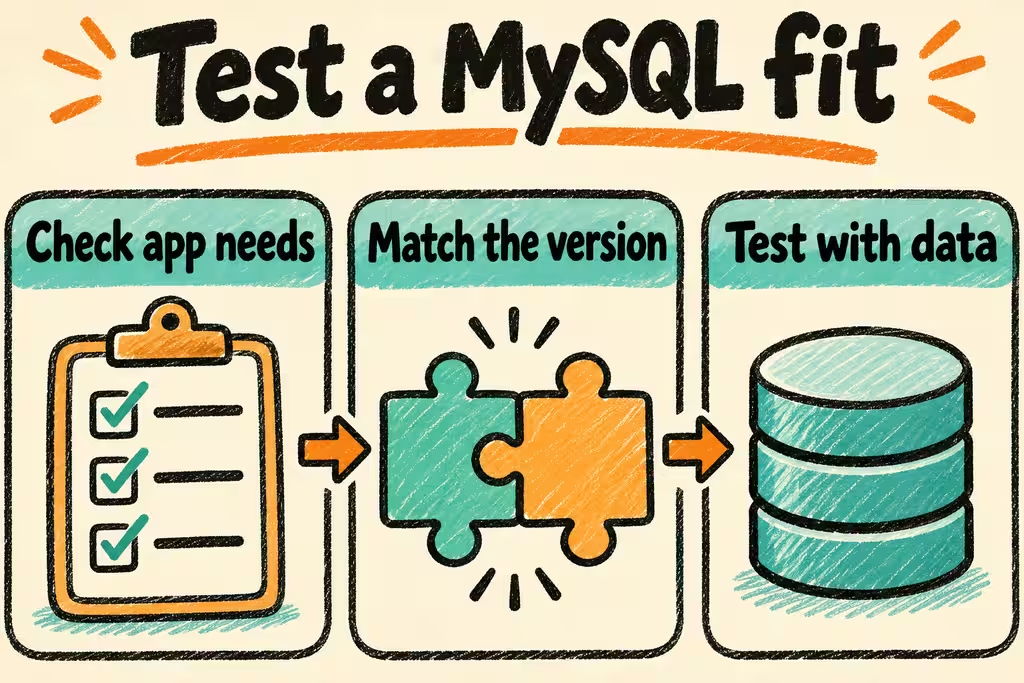
Choose MySQL when an application, team or hosting platform already relies on MySQL drivers and deployment tooling, or when it meets the measured requirements of a conventional transactional web application. Compare alternatives if a required query, constraint or database extension is unavailable. Test your application and data on the exact target version.
MySQL Server, InnoDB, and Workbench
MySQL Server accepts queries and stores data. InnoDB is its default storage engine for transactional tables. MySQL Workbench is a separate visual tool for tasks such as SQL development, schema design and administration. Run the server on a private staging host when testing with realistic data. A browser-based SQL demo is appropriate for disposable examples.
| Need | Start here | Verify |
|---|---|---|
| Run a CMS or product already tested against MySQL | Use the supported MySQL release line and its documented configuration | ORM migration, charset, collation, TLS and backups |
| Learn queries or inspect a test schema | Workbench or the MySQL command-line client against a disposable server | The client can reach the server with a limited test account |
| Move a replicated service or change primary keys | Stage the changes on a representative copy with a replica | Business-key mappings, join results, replica lag and rollback |
| Port from a different relational engine | Inventory SQL and driver behavior before converting schema | Types, rounding, time zones, generated values and collation-sensitive uniqueness |
What went wrong in two HN migrations
el1s7 submitted a MySQL upgrade write-up in which promoting an upgraded environment revealed different identifiers after an earlier primary-key migration. The operator found that one related table still pointed to incorrect rows. The case supports checking business-key-to-ID mappings across source and replica before promotion, even when both appear healthy.
In a separate thread, gpaulbagetti described a periodic MySQL-to-warehouse sync that looked healthy yet missed deletes and intermediate updates. Their report motivates checking end to end whether snapshots are enough. If audit history or downstream deletes matter, verify what the selected connector reads from the binary log.
Validate the upgraded server before cutover
Capture source settings, schema, peak query patterns and replication or connector configuration. Include case variants and non-ASCII fixture values if user data contains them.
- Restore a sanitized copy to the pinned MySQL version. Run migrations and verify key relationships with business identifiers, case-sensitive uniqueness expectations, rounding and timestamp round trips.
- Run representative read and write traffic at expected concurrency. Use EXPLAIN on critical queries and compare p95 latency and error rates against the old baseline.
- If staging has a replica or warehouse consumer, run insert, update and delete cases and compare resulting rows and key mappings. Rehearse promotion and failback with the write window documented.
- Proceed only if checksums or business totals agree, replica behavior fits the agreed lag limit, and rollback has a verified place for newly accepted writes. Stop if any cross-table references silently change.