 Knowledge Library
Decision in brief
Write the claim as a single testable sentence. Trace it to the earliest available record, check whether that record actually supports the claim, and look for an independent account or a correction. If you can verify only part of it, narrow the wording to that part and leave the rest unresolved.
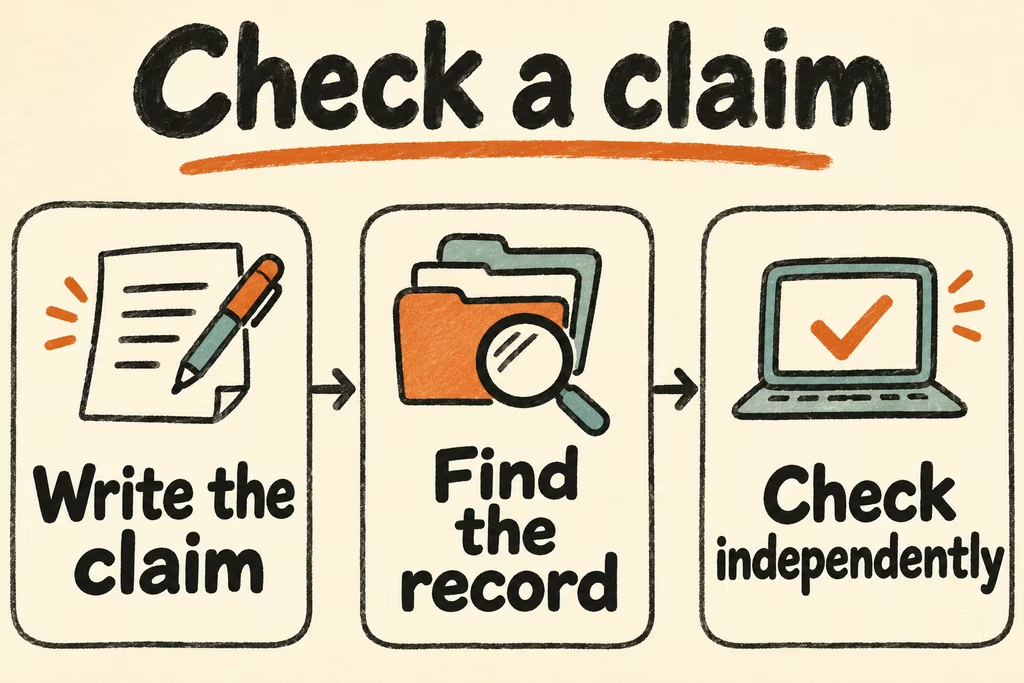
How to verify news sources by claim type
A source can be credible for one question and weak for another. A publisher can establish when it withdrew a story. A recording or transcript supplies evidence for what someone said. A statement from an interested party establishes its position and may point you to records that can be checked independently.
Record four dates separately when they differ: the event, the original publication, any revision, and when you retrieved it. Count independent evidence paths. Ten stories that cite the same notice still depend on that notice. The Library of Congress primary-source guide offers a way to distinguish an observation from an inference and turn a gap into a question.
| Claim type | Start with | Required check |
|---|---|---|
| Direct quotation | Original recording, transcript, or written statement | Confirm exact wording and surrounding context |
| Number or trend | Underlying data table and its documentation | Reproduce the number using the same denominator, dates, and units |
| Screenshot or visual claim | Original publisher or archive and capture date | Match the unedited visible details and separate what is shown from the caption |
| Claim about a dispute or correction | Original article, correction notice, and attributable responses | Timestamp each record and distinguish convergent facts from claims in dispute |
Two news verification case studies from HN
In a discussion of an Ars Technica retraction, j0057 flagged that the notice did not link to the original article and pointed readers to an archived copy. The publisher says it retracted an article containing fabricated quotations. A useful correction record lets a later reader identify exactly which claim and version changed.
In a separate thread, ChrisArchitect linked the WIRED article alongside GrapheneOS's published responses to the publication's questions. That pairing gives readers documents with different authors and purposes. Write down the contested assertion, the response, and any evidence that could independently resolve the difference.
Run a 20-minute verification drill
- Choose two public, non-sensitive claims such as a release date and a direct quote. Record the exact wording and what would prove or disprove each claim.
- Save the original record or mark it unavailable. Log the publisher, date, version, exact location within the record, and any later correction.
- Look for a source that gathered its evidence separately. Check whether it addresses the same claim and dates. Recompute any arithmetic or reread the quote in context.
- Publish only the wording a second reader can reproduce from your notes. Stop or label the claim unresolved when the primary record, definition, or independent evidence required for the conclusion is missing.